Monday, May 16, 2011

Howard Marks’s Missives, Now for the Masses

The writings of Howard Marks, chairman of Oaktree Capital Management, have a cult following on Wall Street.
Published about six times a year, his memos to Oaktree clients have become required reading in certain investment circles. The dispatches have been praised by everyone from Warren E. Buffett to “Tyler Durden,” the anonymous blogger for Zero Hedge, the popular finance Web site. Mr. Durden recently called Mr. Marks “one of the most thoughtful observers on the markets” and described his recent memo on gold as a “must read.”
After 20 years of churning out the letters, Mr. Marks is now a published author. His book, “The Most Important Thing,” was released last week by Columbia Unversity Press. In 192-pages, he weaves excerpts from two decades’ worth of the missives into a single volume, dispensing gobs of investing insights obtained in his 42-year career.
Oaktree, based in Los Angeles, manages $82 billion for clients, mostly in fixed-income strategies. Mr. Marks and four co-founders started the firm in 1995 after spinning out from the asset manager TCW. Before TCW, Mr. Marks, a native New Yorker, spent 16 years at Citibank, where he began as a stock analyst and later managed convertible and high-yield bond portfolios.
DealBook’s Peter Lattman recently caught up with Mr. Marks, who was back at work in London after returning from his 65th birthday celebration in Spain.
Q.
When did you realize that your memos were reaching a broader audience than just your clients and colleagues?
A.
Well, I wrote the first memo in 1990, and it was two pages about what I called “The Route to Performance,” how it’s through consistency and loss avoidance rather than spectacular achievements. And I had no response. On the first day of 2000, I published one called “Bubble.com,” about how I thought that the tech stocks were a bubble. Within a few months that proved right. I then started to hear from people. So after 10 years I became an overnight success.
Q.
The book’s title comes from your first 19 chapters, each one arguing this thing or that thing is the most important thing in investing. Who came up with that device?
A.
Actually, I’ve used it before. I published a memo several years ago called “The Most Important Thing.” I wrote that I found myself sitting in a client’s office saying the most important thing is controlling risk. And then 15 minutes later I say the most important thing is buying cheap. And then 15 minutes after that, I say the most important thing is realizing that you don’t know what the future holds. So I said these are all the most important things.
Q.
The book draws heavily on newspaper articles and the writings and quotes of famous investors, even Mark Twain. I have this image of your traveling around with a pair of scissors and a burgeoning file of newspaper clippings. Tell me about your writing process.
A.
That’s just what I’ve been doing this morning. I have a clip file spread out on my desk for the next memo. It’s working title is “How Quickly They Forget,” and it’s about short memories and how that dooms people to repeating mistakes. Nobody remembers the crisis anymore.
Q.
I recall a John Kenneth Galbraith quote from your book related to that.
A.
Galbraith said: “Contributing to euphoria are two further factors little noted in our time or past times. The first is extreme brevity of a financial memory. Financial disaster is quickly forgotten. When the same or closely similar circumstances occur again, sometimes only in a few years, they are hailed by a new, often youthful, and always supremely self-confident generation as a brilliantly innovative discovery.” What could be more true of the years leading up to the crisis?
Q.
You call Los Angeles home, but for the past half-decade you and your wife, Nancy, have spent four months a year living in London. What effect has that had on your investment outlook?
A.
I think it has given me, and hopefully the firm, a more global perspective. London is now our second largest office. The other thing is that I find it very interesting to look at the United States from the outside.
I’ll give you one brief example. Think about gold. We tend to think that what’s been happening with the price of gold is that it is now worth more dollars than it used to be. But outside the United States when you talk to people, you see people think that it’s not an increase in the price of gold in terms of dollars but a decrease in the price of dollars in terms of gold. And seeing it reflectively like that I think is very helpful.
Q.
Other than you and your Oaktree colleagues, if you had to pick one person to manage your money who would you choose and why?
A.
In the late ’60s, when I was a rookie analyst following office equipment companies, a portfolio manager asked me, “Who’s the best sell-side analyst on Xerox?” I answered, “The one who thinks most like me is so-and-so.” As far as I can tell, Seth Klarman of the Baupost Group and I think the most alike. His returns are great and his risk control is stellar.
Q.
In your book you mention Michael Milken as a major influence. His creation of the junk bond market played a key role in your career.
A.
Marshall McLuhan said “the medium is the message.” I think high-yield bonds have been the medium for a lot of my philosophy. Your philosophy comes from the events you live through. I started at Citibank in the late ’60s when the bank was what was called a Nifty Fifty investor. It bought the stocks of the best companies in America: IBM, Xerox, Merck, Coke, etc. Once analysts ascertained that the growth prospects were bright, the stocks were bought without regard to valuation and we ended up paying P.E. ratios in the 80s and 90s. A few years later you had lost 90 percent of your money.
Then I met Mike Milken in ‘78, and he said if you buy the bonds of B-rated companies and they survive, all the surprises will be on the upside, and a little light bulb went on. I realized that you could invest in the debt of the worst companies in America and make a lot of money if you were paid an appropriate risk premium. That’s really a big part of the philosophy, that quality investing is not about buying good things, it’s about buying things well. The most important thing is the relationship between price and value. If you can figure out the fair value of an asset and buy it for less, that is the best, most dependable way to invest.
Q.
You mention Milken but not me, which is frankly a bit disappointing because I once make an appearance in one of your memos, albeit anonymously.
A.
That memo was from early October 2008. We were speaking and I told you we were buying aggressively, and you said to me, “You are?!” That conversation became the basis for a memo. We decided that if we’re spending a lot of our clients’ money during what some people thought was about to be the end of the world, we should at least fill them in. So we talked about how this is the third debt crisis we’ve lived through, and to us the pattern was obvious and the wrongness of not buying was obvious. There’s a canard that people retreat behind in a crisis. They say you really shouldn’t try to catch a falling knife and they say we’re waiting for the dust to settle and the uncertainly to be resolved. Then by the time the dust settles and the uncertainty is resolved and the knife clearly stops falling, there are no more bargains.

Tuesday, May 10, 2011

Howard Marks and Steve Romick notes from Value Investing Congress presentations

Howard Marks (Oaktree Capital): Oaktree manages over $80 billion and we've covered Marks' insightful commentary numerous times. His presentation highlighted the "human side of investing" and the difference between theory and practice. The manager said he splits investors up into two categories: those who know and those who don't, pointing out that it's what investors *think* they know that gets them into trouble. Risk can be introduced when investors overestimate what they know about the future.

Marks says that the main difference between value and growth investors is that value investors focus on the present. He went onto say that, "(The) most important science for investors is psychology. Investors who have their psyches under control will do best." This of course beckons the age old concept of not letting your emotions get in the way of making rational decisions.

He also went on to focus on the importance and difficulty of being contrarian and that market tops typically occur during a time of rampant bullish euphoria. Marks noted that pro-cyclical behavior is a huge mistake.

Oaktree's funds currently have a lot of cash on hand as opportunities are not abundant; Oaktree seems to be doing more selling than buying these days. He also mentioned he thinks that most institutions over-diversify.

Marks said that the gist of his presentation is featured in his new book that we highlighted yesterday, The Most Important Thing: Uncommon Sense for the Thoughtful Investor.


Steve Romick (First Pacific Advisors): Romick noted that enticing opportunities today are scarce and compared it to trying to ski in the middle of summer. The one pocket of snow he does see potential in is large cap stocks as he believes small caps are overvalued.

Romick presented CVS Caremark (CVS) as a business with good tailwinds and a store footprint that's hard to replace. He says the company is undervalued, trading at a P/E of 12.2x net of the pharmacy benefit management (PBM) hedge. He also points out that management owns a lot of stock and that private label is an opportunity for them to grow as it's only 17% of revenue right now.

Interestingly enough, CVS also seems to be under pressure to split up from its previous merger (combining drugstore chain CVS with pharmacy benefit manager Caremark). Numerous analysts and investors believe the break-up value is much higher than CVS' current share price. Rival Walgreen's (WAG) recently sold-off its PBM segment.

Lastly, Romick also gave another investment idea in Hong Kong traded Goldlion (HK 533). It is an apparel and goods manufacturer in China that caters to the mid-high end consumer, akin to Coach or Polo.

Monday, May 09, 2011

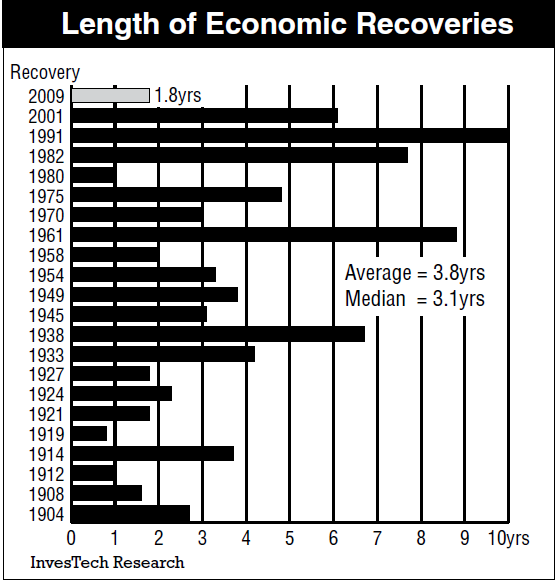
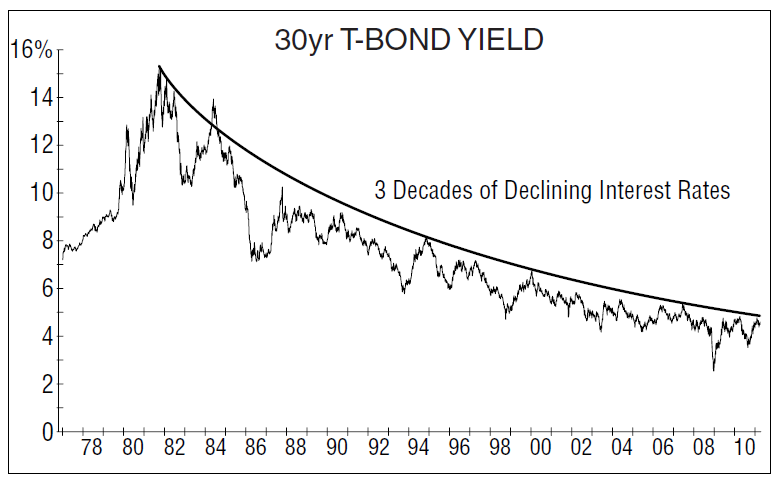
Chart(s) of the Day: Length of Recoveries, Interest Rates

Jim Stack of Investech Research [1] always uses these terrific, informative simple charts. They are not fancy, but they simply convey an incredible amount of information:
The two below are a month old (April 8, 2011) but still instructive:
>
click for larger graphics
[2]
>
This chart tells you almost everything you need to know about the 1982-2000 bull market, the 2003-07 credit driven bear market rally, and the subsequent collapse and bounce back — as well as the demise of the Dollar.
Unbelievably informative.
[3]

Is Managed Futures an Asset Class?

By Attain Capital
A few weeks ago we posted on Mack Frankfurter of Cervino Capital’s recent discussion of managed futures and whether or not it is an asset class. Mack argues that it is not, resting his case on the logical fallacies prevalent on the other side of the debate. When considering why managed futures were often described as an asset class, Mack’s explanation was simple: people are lazy.
Mack’s Cervino Capital is one of the CTAs we track, and we have a lot of respect for him and his program, so his comments gave us pause. Mack is not alone in this assessment. As Mark Kritzman of Windham Capital Management speculated in 1999,
…some investments take on the status of an asset class simply because the managers of these assets promote them as an asset class. They believe their investors will be more inclined to allocate funds to their products if they are viewed as an asset class rather than merely as an investment strategy.
We frequently refer to managed futures as an asset class on our blog and in our newsletters, so we had to wonder… were we just being lazy? Is “asset class” the wrong descriptor for managed futures?
We decided to research the idea to make our own, informed determination on the subject, but realized as we began our quest that a key ingredient was missing from the equation. It was absent from almost every piece we found, including Mack’s.
We were missing a good definition of an asset class.
Defining an Asset Class
There are a couple of problems with pervasive definitions of asset classes. For one, half of them define asset classes while using the word “asset,” and any good debater will tell you that this practice leads to confusing and vague explanations. The other half of available definitions seem to parametricize asset classes to stocks, bonds and cash, and while most figures in the financial industry will identify these common investments as asset classes in their own right, examples do not a definition make.
If you search beyond the surface definitions, you will find more nuanced and complicated explanations. Even here, finding a warranted explanation was difficult. Many authors simply asserted qualifications for asset class consideration without providing any kind of logic as to why those qualifications were pertinent to the discussion.
To save you from a 200 page literature review, we’ll generally define an asset class asA grouping of investment opportunities that behave and are treated in a similar manner.
The explanations for this definition presented by Anson, Fabozzi, and Jones (2010), Focardi and Fabozzi (2004), Gibson (2008), Winograd (2004), Hall (2004), Considine  (2004), and Swensen (2005) give versions of the following specific qualifications of an asset class:
1. The asset class should be subject to similar regulatory guidelines.
2. The asset class should have a significant amount of capital allocated to it.
3. The performance of the asset class should not be able to be replicated by other established asset classes.
4. Risk and return characteristics of all portions of the asset class should be similar.
Why these qualifiers? We selected these 4 test points for three reasons. First, traditional asset classes were able to pass all four tests. Second, a plurality of authors described each of these points or a variation therein as a defining factor of an asset class, providing a comfortable consensus for each point. Third, each of these four points, unlike many others proposed in the literature base, had multiple explanations attesting to their significance as a test of value, which gave them more merit than the qualifiers that were merely asserted.
In order to determine whether or not managed futures was an asset class, we evaluated whether or not it met each of these four standards
Testing the Definition
1. Are all portions of ‘Managed Futures’ subject to similar regulatory guidelines?
Managed futures has this one locked up pretty good, with managed futures comprised of those programs managed by professional money managers who are registered as Commodity Trading Advisors (CTAs) with the Commodity Futures Trading Commission (CFTC) and National Futures Association (NFA). This registration mandates strict levels of disclosure and reporting, and is applied to nearly all forms of managed futures programs, no matter what strategy they may implement(some very large programs and foreign programs may not register).
But despite some exceptions, no matter if a manager is trading stock index options or Corn spreads, they are subject to the same regulations.
Does managed futures pass this definition of an Asset Class? YES
2. Does ‘Managed Futures’ have a significant amount of capital allocated to it?
BarclayHedge puts assets under management (AUM) at the end of 2010 for Managed Futures at $267.6 Billion. This is after an explosion in managed futures investing following the 2008 financial crisis, and leaves managed futures as the single largest investment strategy amongst hedge fund strategy types (merger arbitrage, global macro, private equity, etc)according to the BarclayHedge data (although some larger funds labeled as managed futures programs in the BarclayHedge database are not solely dedicated to the space)
[The data here is, in part, from new investment, and, in part, from investment gains]
Since 1980, AUM for managed futures has increased over 863%, with an average increase of 27.7% per year. Some managed futures commentators are even predicting that AUM for CTAs will pass $3 trillion by 2021. Whether that happens or not, the data shows that Managed Futures have this requirement easily covered.
Does managed futures pass this definition of an Asset Class? YES
3. Can the performance of ‘Managed Futures’ be replicated by other established asset classes?
Managed Futures are a bit of a slam dunk on this front as well, with their whole purpose in life (seemingly) to perform when other asset classes are not. If they don’t follow what other established asset classes do, they can’t be replicated by those asset classes. For proof of this, one need only look to 2008, when managed futures were up 18.33%, compared to bond returns of 10.77%, and stock market losses of 38.49% [past performance is not necessarily indicative of future results].
For the more statistically inclined, performance replication, in this instance, is best measured in terms of correlation. As a refresher, correlation is a statistical figure with values which range between -1.00 and +1.00, meant to show how inter-related two sets of data (in this case monthly % returns) are. If they have a correlation of 1.00, they are perfectly correlated, meaning when one market rises 1%, the other will do the exact same, and when one loses -1%, so will the other. If they are at -1.00, they are exactly opposite; with one making the exact opposite amount the other loses each day, and vice versa.
Given that the only three asset classes that everyone seems to be able to agree on are stocks, bonds and cash, we calculated the rolling correlation coefficient of managed futures against the monthly performance of each of these classes over the last 15 years to see how managed futures stack up for this definition of an asset class.
[Past performance is not necessarily indicative of future results; Data Source: Stocks = S&P 500; Bonds = Citiworld Bond Index; Managed Futures =BarclayHedge Managed Futures Index]
As we expected, the calculation of 12 month rolling correlations going back over the past 15 years showed the wildly oscillating lines typical of non-correlation. In fact, over the 15 year period, we found managed futures had a correlation of -0.078 to Stocks, -0.140 to Cash and 0.296 to bonds. Statistically speaking, this tells us that the performance of managed futures cannot be explained by the performance of traditionally accepted asset classes. In other words, you cannot replicate managed futures performance with these other asset classes.
Does managed futures pass this definition of an Asset Class? YES
4. Are the risk and return characteristics of all portions of ‘Managed Futures’ similar?
This is the hardest definition for managed futures to meet, as managed futures spans investment strategies as diverse as long term trend following of bond and currency futures, to naked selling of stock index options, to spread trading of grain and energy markets.
Statistically speaking, many of those different types of managed futures investments ARE NOT similar. In fact, many pride themselves on their non-correlation with the main managed futures indices, and market that fact.
At the same time, many of these programs are also not correlated with other asset classes, especially during stress periods for the traditional asset classes. This is because, despite their non-correlation with each other, they generally still share the most common denominator in terms of risk and reward characteristics for managed futures programs - their long volatility profile.
This long volatility profile is what allowed the majority of managed futures programs we track at Attain to post profits in the incredibly volatile markets of 2007 and 2008. One strategy type which does not share this long volatility profile (by design), is option trading. But does one outlier on one of four definitions of an asset class nullify all of managed futures as an asset class? We say no, others may say yes… But consider that not all stocks perform similar, either; nor all bonds (just look at Portugese debt versus US debt right now). If we could kick just kick option sellers out of the managed futures space, and give them their own registration category and regulatory body – we would solve a lot of the issues in meeting this definition.
For more of an outside the box look at managed futures having the same risk and reward characteristics – we can look at the liquidity and transparency of managed futures program (no matter what type of strategy they employ) as key component which links them as an asset class. The ability to see position level detail, to have individually managed accounts, and liquidate an account in hours to days are common themes amongst all managed futures programs (and indeed several of those characteristics are the result of the programs being under the same regulations and rules of conduct).
Does managed futures pass this definition of an Asset Class?  MAYBE
Addressing Objections
At this point, we are ready to confirm managed futures is an asset class, meeting three of the four criteria handily, and suffering only a single outlier on the fourth definition. But we were of the opinion it was an asset class before writing this, and this is a hotly debated topic, so we don’t mind addressing some possible arguments we’ve seen out there against them being an asset class.
Objection 1: Not all managed futures programs react the same way to market events.
This is the ringer for the non-asset class camp, as we discussed above, as, at the base level, there is no way to defend it. Stock index selling managed futures programs, for example, don’t react the same to market crisis periods as traditional managed futures programs, and are more highly correlated with stock market performance than that of the managed futures indices.
Our best rebuttal is that not all stocks and bonds (asset classes by nearly all accounts) react the same to market events, either. For example, airline stocks may fall after a spike in Oil while oil companies stocks rally on higher revenue projections. In bonds, you can easily imagine a bond backed by the revenues of a toll bridge, versus a bond backed by the profits of a shipping company – reacting very differently to market events, and indeed, being not very correlated with one another. How correlated have Greek government bonds and US government bonds been over the past two years, for that matter? We would assume the correlation is at about -0.98 (out of a maximum of -1.00).
Yet despite obvious examples of outliers in the stock and bond asset classes, nobody questions whether they are an asset class.
Objection 2: Managed futures trade stock indices, bonds, and currencies – not just commodities; meaning they are more a part of the hedge fund asset class (essentially global macro funds) than their own.
This is a hasty generalization, in our opinion, that rests upon assumptions about hedge funds even being an asset class. There are two responses here. First, the performance of hedge funds and whether or not they are an asset class has nothing to do with whether or not managed futures are an asset class. Given the fact that managed futures meets the tenets outlined in our definition, our conclusion, we feel, is well-warranted. Second, if you look at hedge funds, one particular tenet of our analysis indicates why they are not included in the asset class, technically.
Hedge funds have been difficult to peg. They operate in a realm where disclosure is often optional, and as such, sufficient data from which to draw conclusions is difficult to find. That being said, Professor Harry Kat of the Cass Business School at City University, London, published a paper in 2007 that collected every shred of data available, and he concluded that hedge funds, more often than not, “have a very high correlation with the stock market and therefore make lousy diversifiers.”
We recently reposted commentary from Welton Investment Corporation in this space as well, which did an excellent job of explaining this diversification problem, showing that most hedge fund strategy types correlate more closely with equities (the stock asset class), that any other asset class. Interestingly, they found that the Global Macro hedge fund strategy type, which those who object to managed futures as an asset class argue should be the category managed futures is assigned to (instead of their own asset class), is more closely linked to managed futures than other hedge fund types.
It’s as if managed futures and hedge funds should do a trade, Global Macro for Option Sellers, putting both of those investment types into asset classes which more closely mirror their risk and return profile.
We can hear the objections now. “You’re saying hedge funds can’t be considered asset classes because they invest in a traditional asset class and, as such, have a high correlation. Couldn’t that be said of commodities and managed futures?”
Objection 2a: Managed Futures invests in commodities and as such is highly correlated (i.e not different) than the commodity asset class.
If you look at commodity performance, the only objective way to do so is to look at it from a long-only perspective as well. This is another way in which managed futures separates itself from the pack, because they can go long and short, making correlation between managed futures and commodities next to impossible. At times managed futures will be correlated with commodities (when they are long commodities), but at times they will be nearly perfectly negatively correlated (when they are short).
Just take correlation between managed futures and the S&P GSCI- which measures returns across commodity sectors from a long only perspective- over the past 15 years. The average correlation we found was only 0.228.
[Past performance is not necessarily indicative of future results]
Objection 3: Managed Futures performance is not easily replicated within the managed futures space.
While replication of the asset class within the asset class was not a definition we happened upon, it is an objection we come across from time to time. And it makes sense. After all, we can pretty easily buy S&P 500 futures, a total stock market mutual fund, or a sector ETF to replicate the stock asset class, and bond futures, funds, or ETFs to replicate the fixed income asset class.
But there aren’t managed futures futures (for those reading at the CME – Attain gets the royalty if you come out with this), and despite the attempts by an increasing number of firms, there haven’t been mutual funds or ETFs which have had success matching the performance of the managed futures indices.
From an individual investor standpoint, this takes on more meaning, as they may be invested in a $50,000 program such asClarke Global Basic- which is down for the year- while managed futures as an asset class is up. Or they may have invested in managed futures in 2008 via an option selling program, only to find steep losses at the end of the year while managed futures as an asset class were up.
This frustration is real, and this objection to managed futures as an asset class is the most damning, in our opinion, as we know how hard it can be for a single investor without a lot of capital to replicate the performance of the managed futures indices in any one month, quarter, or year. The less capital an investor has, the harder it usually is for them to replicate managed futures performance as a whole – because they are forced to rely on a single strategy type. The odds of any one strategy type varying from managed futures as a whole are pretty large.
Our rebuttal to this would be that the same thing can happen in all asset classes, where the performance of a single stock may greatly lag the general market, or a single bond sees its value go to zero on a corporate default while bonds in general post decent returns. The one point we don’t have a rebuttal to is the easy access to the whole asset class via an affordable ETF or mutual fund, like you can get with the SPDR.
Conclusion
The status of managed futures as an asset class has long been in debate, and it is unlikely that this publication, or any other, will put the issue to rest anytime soon. However, based on the literature we’ve reviewed, the data we’ve compiled, and the analysis we’ve conducted, we feel confident in our assessment of managed futures as a distinct asset class.
And despite our point by point methodology outlined above, the best argument for it being an asset class is usually the rather simplistic statement – if it isn’t an asset class, then what is it? We have yet to hear a good response to that question.
Does the conclusion fly in the face of what people understand to be true, intuitively, about asset classes?  Did we skip some points and objections such as benchmark analysis? Sure, but until academia comes up with a better definition for what an asset class is, managed futures, as we understand it, is an asset class.
The real question here is what that conclusion means for potential investors. If managed futures are indeed an asset class, then they should not just be the realm of sophisticated investors and those with risk capital. They should be right up there with the seemingly carved in stone 60/40 stock and bond split that so many of us have been taught and told time and again as the optimal asset allocation mix.
The implication of managed futures being an asset class is that we need to get out the stone grinder and change that stodgy old 60/40 into a more reasonable 33/33/33. We aren’t the only ones who feel this way. In fact, Opalesque recenty published an article that argues that managed futures could actually replace bonds in the traditional portfolio.
When it is all said and done, the whole point of the debate is to decide whether managed futures actually add anything to a portfolio, or whether they are just another way to get the risk and reward profile you get with the traditional asset classes. We’re here to say with confidence that they do a lot more than the traditional asset classes. They will have losing periods, they will run in tandem with the other asset classes at times, but they do meet the definitions of a separate asset class, in our opinion, and, as such, demand consideration as part of a diversified portfolio.
While your stock broker and investment advisor will likely go on and on about the risks involved in futures (and there are substantial risks), we will say that the bigger risk lies in ignoring managed futures as an asset class.
To read more Managed Futures research pieces, visit Attain’s Managed Futures Newsletter archive.  Click Here.

Inflation: embedding or decamping?

Are the inflation risks in emerging markets exaggerated? Yes, says Capital Economics in a report published on Monday which argues that the inflation fears spooking EMs will “prove short-lived”. Not true, says HSBC Asset Management, which argues investors are “overly sanguine on EM inflation prospects”, with the consensus lagging reality.  The key to the argument is how far rising global commodity prices trigger second-round inflationary effects in individual countries. And how fast the authorities intervene.
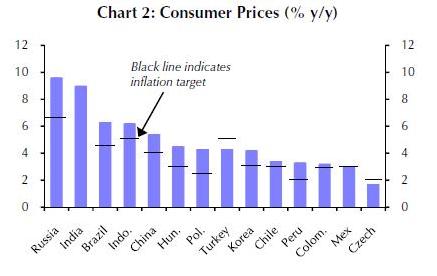
Capital Economics argues that while inflation is above official target levels in 11 of the 14 largest EMs (see chart) and will edge higher in coming months it should peak in the fourth quarter.
An official report  from Brazil on Monday adds weight to the argument, with the central bank saying that economists are reducing their forecasts for inflation to 6.33 per cent for CY 2011, down from 6.37 per cent last week. It was the first reduction in nine weeks.
Capital Economics - consumer prices


Global commodity price increases are still working their way along the economic chain pushing up inflation. But the cycle should soon be complete. Capital Economic says:
Even if global commodity prices now simply stabilise at their current high levels, food and energy inflation should still start to fall by around Q4 of this year. But if last week’s drop in oil prices proves to be the start of a series of falls in global commodity prices, as we think likely, food and energy inflation could drop sharply next year.
Either way, the key point is that the unwinding of the commodity price shock, coupled with a more general slowdown in the global economy, should lead to a fall in headline inflation in most emerging markets next year.
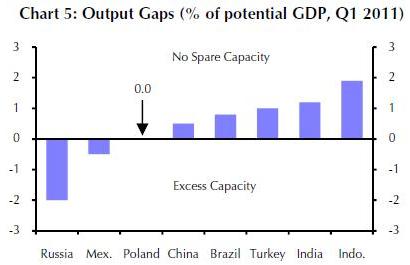
capital economics - output gaps


Capital Economics – not known for being bullish – admits there are domestic inflationary pressures in some countries, including Indonesia, India, Turkey and Brazil. But China is less vulnerable. And overall the scene is set for an eventual recovery in investor sentiment towards EMs.
The upshot is that the inflation fears that have spooked financial markets in emerging economies over the past week or so are ultimately likely to prove short-lived.
Other headwinds remain – most notably fears for the global recovery. But with growth in the developed world likely to remain sluggish, the hunt for higher returns should eventually pave the way for a renewed influx of capital to emerging markets and thus further gains for EM equities and bonds.
For HSBC Asset Management this is is too optimistic.  In a report published last week, entitled “Who let the tigers out?”, Philip Poole, global strategy head, quotes approvingly from Wen Jiabao, the Chinese prime minister. “Inflation is like a tiger: once set free it is very difficult to get back into its cages,” said Wen in March – and Poole seems to agree.
First, he says, the upswing in commodities is “more trend than cycle” driven by EM demand for energy, materials and food. Next, the second-round effects of inflation – in which domestic companies and workers participate by pushing up prices and wages – are serious.  Shortages in capacity and skills mean EMs are far more prone to such pressures than DMs. He argues:
This creates the risk that in emerging economies inflation shocks turn into self-perpetuating inflation processes as expectations adjust higher and become embedded.
Finally, EM central banks’ ability to control inflation through interest rate increases is damaged by the US Federal Reserve sticking to very loose monetary policies. So instead of raising rates, central banks are turning to controls on banks, but it is unclear whether this will work. The longer central banks put off interest rate increases “the bigger the risk they slip behind the curve in combating inflation.”
For Capital Economics, the implications for investors are straightforward – buy EM stocks and bonds, taking advantage of market dips. For HSBC AM, with its longer-term concerns about inflation, there are no simple answers. Poole suggests buying asset-intensive sectors including banks and minerals groups.  He backs Russia (energy-rich, prospects for rouble appreciation) and Latin America (agricultural commodities). In Asia, he likes asset-intensive companies in South Korea, Taiwan and Hong Kong. Meanwhile, bond investors can look at EM index-linked offerings.

Wednesday, April 27, 2011

"Crisis Insurance"

Beta comes in different shapes and sizes: plain vanilla and exotic, bull beta and bear beta. Alpha is no different and positive crisis alpha avoids the Achilles’ heel of other varieties: it doesn’t disappear when you most need it.


The Chicago Mercantile Exchange (“CME”) in this new paper defines crisis alpha as performance during equity bear phases, such as late 1998, 2000-2002 and 2008. Unsurprisingly, the two equity hedge fund strategies that avoid long exposure to equities have produced positive crisis alpha: equity short biased and equity market neutral managers. CTAs, which can be long or short equities, are the other only hedge fund strategy that delivered positive crisis alpha – so say the CME. Every other hedge fund strategy, according to the BarclayHedge indices, suffers from negative crisis alpha, as the chart below shows. (Click the chart to enlarge.)
What is more striking is that CTAs actually need crises to generate their returns. Strip out crisis periods and you can cut in half the BarclayHedge CTA index returns, as the graph below illustrates.
And precisely the opposite applies to hedge funds in general: exclude the crisis periods and the returns will double.
You don’t need to be a Nobel prize winner to figure out that CTAs can act as crisis insurance by effectively neutralising the negative periods for the other strategies. That said, Harvard’s 1990 Nobel Prize Winner and “Father of the Capital Asset Pricing Model” John Lintner did make such a case for CTAs as diversifiers long ago in 1983 with this antique typewriter-written paper. (Editor’s Note: Think weird kind of printer with keyboard attached and no wifi…)
Where is the crisis alpha coming from? To answer that, the CME splits investment risk into three categories – price risk, credit risk and liquidity risk – that are normally pretty independent of one another. But in a crisis like 2008, liquidity and credit risk take the driving seat and synchronise investor behaviour which manifests itself in heightened price risk for most investors– but strong trends for some to follow. CTAs, which mostly follow trends, are well positioned to latch onto the big moves, which is why 2008 was their best year since 2002 or 1998, depending on which index you look at.
Some investors, the CME implies, may have overlooked CTAs by focusing on their easily visible price risk and relatively low standalone Sharpe ratios as shown below (to the exclusion of less obvious credit and liquidity risks, which we already discussed on AAA here and here).
The CME argues that CTAs are exposed to more price risk, but less liquidity and credit risk – in fact they reap their greatest rewards during credit crises. Price risk, displayed against crisis alpha below, is measured by the degree of mean reversion in return patterns, liquidity risk by the level of serial or month-to-month correlation in returns, and credit risk by correlation with the gap between swap spreads (which face bank credit risk) and US Treasuries (which have historically had no credit risk notwithstanding Standard and Poors’ negative outlook on the US Government and its substantial ownership of banks).
Cynics might say that as the world’s largest clearer of futures, clipping a small fee on each and every contract traded, the CME has a vested interest in seeing investors allocate more money to CTAs that trade futures – the skeptics might have a point. However, going forward, regulators are migrating all kinds of other derivatives onto exchanges, including credit derivatives, and the CME is not making any special case for credit funds. Besides, not all CTAs have to trade futures: some specialise in currencies, which still trade mainly over the counter and could very well continue to do so.

One point the CME did not make is that synthetic replication approaches may also be to recreate a CTA return profile, and these do not always involve trading futures. One of the oldest replication techniques identified by Fung and Hsieh in this 2001 paper involves owning a basket of look-back straddles (puts and calls both at the money) that would probably be traded OTC bypassing exchanges.  So, the CME is educating investors about the benefits of CTA strategies, but the educated investor also has a menu of vehicles at their disposal to access positive crisis alpha from such strategies.

Tuesday, April 19, 2011

small has been beautiful


The concept for today’s chart comes from Ned Davis Research.  This is its chart AA144, in which the value in the bottom panel is called an “equity risk premium proxy.”  It is the spread between the Moody’s Baa yield to maturity and that of the Treasury ten-year note. In the top panel is the ratio of the Russell 2000 to the Russell 1000 — an ascending line means that the smaller stocks are outperforming.  They lagged badly in the late 1990s as the large caps got pushed to huge valuations, but small has been beautiful ever since. One of the great things about NDR’s work is that it provides statistics on performance related to the variables pictured in the charts.  (If you want those details, you’ll have to subscribe.)  For this one, small caps do the best on a relative basis when the risk proxy is high and when it’s falling.  Big stocks generally do better when it’s low or rising. That begs the question as to whether the indicator is low or high.  Well, that and where it’s likely to go from here and why.  Some hints may come from looking at the layers below the surface of this picture — at the somewhat unusual interest rate structure of the day and at the relative valuation of the two indexes. How close are we to the long-awaited time when large stocks as a group look pretty again?  It may make sense to keep an eye out for what’s happening in the bond market to help you decide.  (Chart:  Bloomberg terminal.)

Tuesday, April 12, 2011

2011 Fund of Funds 50: Firms Adapt To Survive Change


To win institutional assets, firms in the Fund of Funds 50 - the world’s largest multimanager hedge funds - will need to prove their mettle.

In their nearly four years managing absolute- return investments for the $140.6 billion New York State Common Retirement Fund, Peter Carey and his team completely rebuilt the third- largest U.S. public pension plan’s hedge fund portfolio, moving from a strategy that depended on funds of hedge funds to a much more elaborate one that focuses on direct investing, portfolio construction and manager selection.
By last summer, Carey thought that other investors could benefit from the insights and expertise his group had developed overseeing the $4 billion absolute- return port folio, which was invested in 28 hedge funds. But New York Common is prohibited from managing outside money, so in November, Carey and his deputy, Robert Mazurek, announced that they had joined SkyBridge Capital II and would launch a new institutional business, SkyBridge Direct.
SkyBridge, No. 27 on the Fund of Funds 50 — Institutional Investor’s annual ranking of the world’s biggest multi manager hedge fund firms, determined by assets under management as of January 3, 2011 — didn’t have a traditional fund of hedge funds until last spring, when it bought Citi Alternative Investment’s hedge fund business. SkyBridge is one of many multi­manager hedge fund firms seeking to diversify their capital bases and attract more institutional money. In doing so these firms are responding to the transformative trends dominating the fund-of-hedge-funds industry today and are working against the increasing tendency among institutional investors — like New York Common — to invest directly in a basket of hedge funds they create themselves.
“At New York Common we realized that we had basically built a fund of hedge funds in-house,” says Carey.
The firms constituting this year’s Fund of Funds 50 run a combined $525 billion, up 4.4 percent from the $503 billion that the 50 biggest firms managed when 2010 began but 40.1 percent less than the $877 billion they had as of mid-2008. The vast majority of the money is invested with the very largest firms. The five biggest managers collectively control 27.5 percent of the assets, as top- ranked HSBC Alternative Investments Ltd and No. 2 Blackstone Alternative Asset Management each saw its assets under management jump by more than $6 billion last year.
The economic collapse that began in late 2007 and accelerated when U.S. investment bank Lehman Brothers Holdings filed for bankruptcy in September 2008 hit hedge funds hard. Overall hedge fund assets under management fell from a second-­quarter 2008 high of more $1.93 trillion to $1.4 trillion at the end of 2009, according to Chicago- based Hedge Fund Research. Fund-of-hedge-fund assets shrank from $825.9 billion in mid-2008 to $571 billion at the end of 2009. Although the hedge fund industry overall is nearly back to its asset total before the financial crisis, fund-of-funds assets had recovered to only $646 billion when this year began.
Much of the reason for the less robust growth of funds of funds is that the bulk of the new assets flowing into hedge funds is from institutions. A March Deutsche Bank survey of more than 500 hedge fund investors representing $1.3 trillion in hedge fund assets found that 80 percent of foundations and endowments, 83 percent of pension funds and sovereign wealth funds and an astonishing 96 percent of insurance companies increased their allocations to hedge funds last year. But 62 percent of these same investors said that none of their new allocations will be made to funds of hedge funds.
Institutional investors are increasingly balking at the extra set of fees that multimanager firms impose. The standard fund of funds adds a 1 percent management fee and 10 percent performance fee to the typical 2 percent and 20 percent that single-­manager hedge funds charge. To survive, fund-of-funds firms are having to adapt and prove their worth.
“Funds of funds are partnering with institutions, and as they do that they are helping educate these investors in alternatives,” says Scott Carter, New York–based head of global prime finance sales and capital introduction at Deutsche Bank. As Carter explains, increased direct investment and fund-of-funds growth can co exist as long as new investors keep coming in, because they often start with funds of hedge funds.
 London-based HSBC Alternative Investments Ltd, No. 1 in this year’s ranking, with $36.8 billion in assets, illustrates how the fund-of-hedge-funds industry is changing. Started 16 years ago and housed within its parent’s private bank, HAIL’s fund-of-funds business has principally catered to high-net-worth individuals and family offices, often based in Europe. But in 2005, HAIL began making a concerted effort to build up its institutional business, says Timothy Gascoigne, HAIL’s global head of portfolio management. He estimates that today these investors make up 40 percent of its fund-of-funds clients and the bulk of the new money flowing into its funds.
Because HAIL has been in the fund-of-funds business for so long, it is invested in some of the top- performing, hard-to-access hedge fund companies, like Tudor Investment Corp. and Moore Capital Management. Gascoigne estimates that one third of the managers with which its main fund has invested are closed to additional capital or new investors. During the crisis, when some closed funds opened, in some cases for the first time in decades, HAIL was able to increase its allocations to those managers because it had cash on hand.
It is hard to beat New York–based Blackstone Group for name recognition among U.S. asset owners. Founded in 1985 as a private equity firm, running money for traditional institutional investors such as U.S. public pension funds, Blackstone entered the fund-of-hedge-funds business in 1990 when it launched Blackstone Alternative Asset Management. Led by former investment banker and Lehman Brothers co-CEO J. Tomilson Hill, No. 2–ranked BAAM commands a massive $34 billion in fund-of-hedge-funds assets, up 22.2 percent in the past year and nearly threefold since 2006.
“For about eight years now, our clients have looked to us to provide investment solutions using hedge funds,” says Hill. “The term ‘fund of funds’ implies a static approach to investing in hedge funds utilizing a finite menu of existing products, whereas our business is focused on customized products using a dynamic process.”
BAAM might be among the best at the customized and advisory business, but the firm is far from alone. Most of the largest fund-of-funds managers offer a bespoke approach. The reason is simple: To justify their fees, fund-of-funds firms need to offer institutions something more than what those investors can do on their own.
An institutional quality fund-of-funds manager can make a real difference, says Kent Clark, New York–based CIO of ­Goldman Sachs Asset Management’s hedge fund strategies group, No. 6, with $20.8 billion in assets. “Having a research process that you can track over time, which means that performance is documented and standards are kept, is a huge advantage,” he explains. “It is about accountability.”
Smaller fund-of-funds managers, especially those below the $3.7 billion cutoff to make this year’s Fund of Funds 50, often are not in a position to customize. But they too want institutional dollars. They argue that size matters — reasoning that the sheer amount of money the very largest firms have to put to work hurts their ability to produce alpha. Managers with fewer assets can adapt more quickly and can invest with small hedge funds, whose performance can be better than those of well-known large hedge funds accessible to everyone.
“One of the things I prefer about our portfolios is that we run the gamut of managers,” says Jill Schurtz, CEO of New York–based Robeco-Sage, a $1.3 billion fund-of-funds firm started by three former Goldman Sachs partners in 1993 and now owned by Dutch firm Robeco Investment Management. Robeco-Sage, which offers customized accounts, invests in larger hedge fund firms, but it also finds opportunities with funds managing $500 million or less. Big funds of funds have difficulty giving money to such small managers, because the investments are unlikely to have a meaningful impact on their results. Some large multi manager firms can get around this in part by operating seeding businesses.
The bifurcation in the market really challenges the fund-of-funds managers in the middle — those that are too big to invest easily in managers with only a couple hundred million dollars in assets but lack the resources of the very largest firms.
At No. 25 on our list, with $7.9 billion in assets, London- based Fauchier Partners is just starting an aggressive marketing push into the U.S. Unlike many of its European brethren, Fauchier’s business is almost entirely institutional. “There isn’t any secret to being a successful fund of hedge funds,” says Fauchier Partners CEO Clark Fenton. “Conceptually, it is very simple, but it is very hard to execute. It is about picking the right managers, doing the operational due diligence to make sure there is no fraud and the investment terms are just and true, then putting the managers in the right combination and sizing up the ones that will do well. The final building block is risk management.”
But for a long time, unwary investors had trouble differentiating among funds of hedge funds — in part because of Bernard Madoff. In December 2008, Madoff admitted that the fund he had been running for more than 40 years was, in fact, a massive Ponzi scheme. Although plenty of fund-of-funds managers saw enough red flags to avoid Madoff, many others gave him money, including some of the best-known firms in the industry. For a time they reaped the rewards.
In mid-2008, Geneva-based Union Bancaire Privée was the largest fund-of-hedge-funds manager in the world, with $56.9 billion in assets. Today it ranks No. 10, with $15 billion, an incredible 74 percent drop in assets. UBP was the eighth-­largest investor in Madoff. Although the firm has taken steps to improve its due diligence process, and is starting to raise new assets, it is having a difficult time winning the confidence of institutional investors.
Madoff proved too much for another investor — Ivy Asset Management Corp., which in 2002, with $6.2 billion in assets, was the seventh-largest firm in the first Fund of Funds 50. Ivy was shut down last year by its parent, BNY Mellon Asset ­Management. With that, BNY Mellon has plummeted to No. 49 from No. 17 on the list, losing 64 percent of its assets.
Last spring, as the fate of Ivy was being decided, one of its partners reached out to the founder of New York–based ­SkyBridge, Anthony Scaramucci, to see if he would acquire what remained of the business and the team. Scaramucci started SkyBridge as a hedge fund seeding firm in 2005. His phenomenal networking skills notwithstanding, New York–based SkyBridge managed less than $2 billion when 2010 began, almost all of which came from family offices and high-net-worth individuals.
To grow the business, Scaramucci knew he needed to do something big. So although he passed on Ivy last April, he announced that his firm was acquiring $6.1 billion in funds of hedge funds from Citigroup. The deal gave SkyBridge a fund-of-funds group with a strong track record and significant institutional business, including separate accounts and advisory clients.
“There is a tendency to think of funds of funds as a separate and distinct business,” says Raymond Nolte, SkyBridge’s CIO, who headed the fund-of-funds group at Citi. “Our vision was to create one continuum in the alternatives space to deliver access to hedge funds in whatever form the client wants.” He anticipates that institutional investors will realize the value of such a full- service business.
SkyBridge will have to contend with investors like the $12 billion West Virginia Investment Management Board, which chose the direct route when it first invested in hedge funds a few years ago. “Given the long-term rate of return we expect and the role hedge funds play in our portfolio, they start to lose their attraction if we have to pay the extra 1 percent or so to invest through a fund of funds,” says executive director Craig Slaughter.
No one knows better than SkyBridge’s Carey how hard running a direct investment portfolio can be, particularly at a budget-­strapped public fund. The difficulty involves not only manager selection, but also constant monitoring and back-office and due diligence work. Additionally, public funds often cannot make the kind of quick allocation decisions that a fund of hedge funds can.
“Investors are going to realize that you have to manage these portfolios,” says Carey.
What SkyBridge and other fund-of-funds managers are hoping is that, after trying the direct approach, some institutions will discover that the professionals do it better.

Monday, April 11, 2011

Pursuing Self-Interest in Harmony With the Laws of the Universe and Contributing to Evolution Is Universally Rewarded

The billion-dollar aphorisms of Ray Dalio, who built the world’s biggest hedge fund by running it like a cult.

If you want to understand Bridgewater Associates, the world’s largest and indisputably weirdest hedge fund, you might start with the story of the peas.
It goes like this: In 2005, while the rest of the financial sector was busy pumping rocket-grade helium into the credit bubble, a young Bridgewater investment associate named Holden Karnofsky was complaining to his colleagues about the food at the firm’s Westport, Connecticut, headquarters. Particularly bad, he said, were the peas in the cafeteria salad bar. At other offices, a bottom-rung underling would probably shrug off such a misfortune and move on to the grape tomatoes, but Karnofsky, who came to Bridgewater via Harvard, felt empowered to post his grievance on the firm’s internal message board. “I didn’t mince words,” Karnofsky recalls. “I told them there was a lot that needed improving.”
Lousy peas may seem inconsequential when billions of dollars are being wagered. But at Bridgewater, a pea is never just a pea. Karnofsky’s complaint made its way to Ray Dalio, Bridgewater’s founder, chief executive, and chief investment officer, who brought it up with other members of the firm’s executive team. According to a person familiar with the episode, Hope Woodhouse, then Bridgewater’s chief operating officer, chided Dalio for paying so much attention to a vegetable mishap, saying, “This is ridiculous. I shouldn’t be spending my time on this.”
Dalio disagreed. He’s decreed that at Bridgewater—which has 1,100 employees and a stupefying $94 billion under management—there is no such thing as a small problem. “By the time I left,” says Karnofsky, “the food definitely got much better.”
Dalio, a tall, gaunt 61-year-old man with a swoop of gray hair, is an adherent of “radical transparency,” a management theory that calls for total honesty and accountability. He’s also a longtime practitioner of Transcendental Meditation and has built its precepts on self-actualization into Bridgewater’s office culture. (He’s even brought in David Lynch, the film director and unofficial TM spokesman, to lead a seminar for his staff.) Dalio expects employees to openly criticize not just the cafeteria fare but also each other; behind-the-back gossip is strictly prohibited. “Issue logs” track mistakes ranging from significant (poorly executed trades) to small (one employee is said to have been issue-logged for failing to wash his hands after a trip to the bathroom) and can result in “drilldowns,” intense sessions—one insider compares them to a cross between a white-collar deposition and the Spanish Inquisition—during which managers diagnose problems, identify responsible parties (“RPs,” in Daliospeak), and issue blunt correctives. Other employees can withdraw recordings of these proceedings from the firm’s “transparency library.”
Should Bridgewater employees need a refresher on the house rules, they can consult their copy of Principles, the 110-page manifesto Dalio has written to codify his philosophies about life, work, and the pursuit of greatness. The book used to be given to all Bridgewater employees in paper form and is now distributed via a custom app. Dalio’s axioms are studied with Talmudic intensity at the firm, and conversations with employees tend to be sprinkled with company jargon: “ego-barrier,” “probe,” and the ultimate Bridgewater insult, “suboptimal.”
“Empathy and kindness aren’t a top priority there,” says a former Bridgewater employee. The firm’s culture of absolute candor is designed to strip out emotional considerations and emphasize cold, Vulcan logic in all decision-making—the thin-skinned need not apply. But firm loyalists insist it sounds worse than it is. “Every organization is absolutely riddled with problems,” says one, “but we have a way of fixing them.” Dalio’s Principles, acolytes say, allow the firm’s researchers and traders to sidestep office politics and ego-stroking and focus on what really matters: beating the markets.
Which Bridgewater has certainly done. Last year, the firm put up the best numbers in its 36-year history, notching a nearly 45 percent gain in its most aggressive fund on its way to a total haul of more than $15 billion. Those returns—which CNBC ­noted were greater than the 2010 profits of Google, Amazon, Yahoo, and eBay combined—vaulted Bridgewater even further ahead in the hedge-fund rankings and reportedly netted Dalio a personal windfall of more than $3 billion.
Post-Madoff, billion-dollar paydays have a way of putting targets on backs, especially amid the insider-­trading scandals now hitting the hedge-fund sector. “They’re just out there in Connecticut, not really part of the scene,” says one Goldman Sachs employee. “But they had a killer year, and with that big a fund …” The Goldmanite trails off. “What do they do? No, seriously. Do you know?” Bridgewater makes it hard to answer that question. Like a lot of hedge funds, it requires its employees to sign nondisclosure agreements designed to keep trading strategies under wraps. Even more than its peers, it cultivates a paranoia in its ranks, monitoring e-mails and phone calls and keeping tabs on employees via a network of overhead cameras. Most of the current and former Bridgewater employees contacted for this article, along with several nonstaffers who were afraid of angering the firm, spoke on the condition of anonymity. But nobody is accusing Dalio of misconduct, and Bridgewater’s reputation among institutional investors is spotless—a recent survey by analytics firm Preqin ranked the firm as the global favorite of public-pension funds.
With nothing scandalous to spread around, finance-world gossips have been left to focus on what a strange, strange place Bridgewater is. When the blog Dealbreaker posted leaked excerpts from Principles last May, the industry got a window into Dalio from his calls for his employees to “humiliate themselves” in pursuit of the truth and his comparison of the process of self-improvement to “when a pack of hyenas takes down a young wildebeest.” Dalio responded by posting the full Principles on the Bridgewater website, but if he thought his ideas would be judged more kindly in context, he was mistaken. “I’m sure our reputation on the Street is that we’re completely insane,” says a current Bridgewater employee. An executive recruiter who works with hedge funds confirms that suspicion, describing Bridgewater as a “bunch of fucking nutcases.”
At the same time, that $94 billion raises a question: What if the nutcases are on to something? “Bridgewater is a very quirky place, and you have to drink the Kool-Aid to fit in,” says another headhunter. “But clearly something is working for them.”
Dalio began his investing career at age 12, when he sunk $300 he’d earned as a golf caddie near his Long Island home into shares of the now-defunct Northeast Airlines. Soon after, the company went through a merger, and its $5 stock price tripled.
Dalio’s parents, a jazz musician and a stay-at-home mom, supported his passion for the markets. After college, he took a summer job on the floor of the New York Stock Exchange and eventually became fascinated by commodities futures—derivatives used by Wall Street firms to reduce their exposure to oil, metals, crops, and other resources vulnerable to price swings. It was at the time an unsexy specialty, but in the early seventies, when the Bretton Woods currency crisis sent the stock markets spinning, investors flocked to commodities, and Dalio’s budding expertise was suddenly in demand.
Don’t pick your battles. Fight them all.

Treat your life like a game.

Manage as someone designing and operating a machine rather than as someone doing tasks.
In 1974, after getting his M.B.A. from Harvard Business School, Dalio went to work trading futures for Wall Street legend-in-the-making Sandy Weill. Dalio stayed at Weill’s brokerage, then called Shearson Hayden Stone, for only a year. (Dalio declined to comment for this article, but several people familiar with the matter said he was fired after bringing a stripper to a client presentation.) He decided to strike out on his own, opening a small advisory boutique with a friend from his rugby team. Neither man had much experience managing money, but the market briefings Dalio sent out were impressive enough to land Bridgewater its first major investors, large pension funds that committed several million dollars apiece. (Today, the firm’s “Daily Observations,”multipage bulletins that include reflections on everything from bond yields to the potential market effects of swine flu, are required reading for pension managers and central bankers around the world.)
While his client base was expanding, Dalio began crafting the investing theory that would make him a multi­billionaire. The global economy was a giant machine, he observed, with certain cycles that repeated themselves during economic and political transitions. If you identified those patterns, as well as the smaller events that seemed to trigger them—a LIBOR blip here, a rising debt ratio there—you could build a computerized system that could predict booms and busts. The approach served Bridgewater well: The firm’s flagship fund has lost money in only three years since its founding and boasts an average annualized return of 18 percent since 1991.
In 2006, Bridgewater’s computers began to indicate that the American economy seemed to be heading for what Dalio calls a “D-process,” a sort of national bankruptcy proceeding in which debt-service payments rise relative to incomes until, under the threat of default, the government is forced to print tons of money and buy up long-term assets. The firm’s traders piled into investments that would be most affected, including, at various times, U.S. Treasury bonds, gold, and the yen. They also studied Japan’s “lost decade” and the Latin American debt crisis of the eighties and used what they learned to program red flags into Bridgewater’s trading system. In the spring of 2008, one of these flags, a risk metric for credit-­default spreads, prompted Bridgewater to pull its entire positions in several banks—including Lehman Brothers and Bear ­Stearns—the week before Bear ­Stearns imploded. In the years since, seeing the crisis coming has become the hedge-fund version of having been at Woodstock, but Dalio and his team actually did it.
Throughout 2010, the D-process continued to unfold. By the end of the year, 80 percent of Bridgewater’s bets were in the black, and even critics who’d mocked Dalio’s eccentricities had to acknowledge his brilliance as an investor.
The path to Principles began early in Bridgewater’s history, when Dalio began to think that employees, like economies, could be understood as following patterns. Transcendental Meditation informed his belief that a person’s main obstacle to improvement was his own fragile ego; at his firm, he would make constant, unvarnished criticism the norm, until critiques weren’t taken personally and no one held back a good idea for fear of being wrong. Dalio’s chosen investment system depended on such behavior. Unlike at a hedge fund such as Steven Cohen’s SAC Capital, where star traders are given chunks of the firm’s capital to run quasi-independent desks (and offset each other’s losses), everyone at Bridgewater essentially contributes to the same strategy as they work under Dalio and his longtime confidants and co-CIOs Bob Prince and Greg Jensen. Dalio thought radical transparency could optimize the hive mind. “The culture makes you have to listen to other people,” says Giselle Wagner, a former Bridgewater chief operating officer.
But six years ago, as his growing firm continued to take on hundreds of new staffers, Dalio saw that culture slipping away. He began pecking out notes on his BlackBerry after meetings in which he felt a core value being misunderstood or neglected. The notes piled up. Eventually, Dalio added an introduction and some explanatory material and distributed the collection to his employees.
A corporate gospel isn’t novel—The Bloomberg Way was required reading for Bloomberg News employees years before Dalio set down his ideas. But Principles is no mere training manual. The first half of the book, “My Most Fundamental Principles,” contains Dalio’s abridged autobiography, an apologia for radical transparency, and a step-by-step guide to “personal evolution.” The precepts in this section—many of them written in a digressive, self-serious style that reads as if Ayn Rand and Deepak Chopra had collaborated on a line of fortune cookies—are never about making money, at least not openly. They’re about following rules, learning from mistakes, reaching your goals. Doing things in the Bridgewater way is thought to be the best—and possibly only—way of achieving these objectives. If you live rightly, whatever happens is okay, since, as he wrote, “self-interest and society’s interests are generally symbiotic.” If the hyenas take down a young wildebeest, well, c’est la vie.
The document’s second half, “My Management Principles,” contains Dalio’s 277 workplace rules: To hold more productive meetings, “enforce the logic of conversations.” When coaching subordinates, “manage as someone designing and operating a machine rather than as someone doing tasks.” And so on.
There is nothing to fear from truth.

When a pack of hyenas takes down a young wildebeest, is this good or bad?

Ask yourself whether you have earned the right to have an opinion.
A skeptic might point out that the primary benefit Dalio believes his maxims deliver—greater efficiency in the search for truth—might be canceled out as man-hours are burned issue-logging and drilling down, and that many of his rules are confusingly contradictory: He admonishes against sweating the small stuff but also encourages gripes about peas. Some employees also note that no-problem-is-too-small can become license to micromanage. (“If I were worth $10 billion, I’d spend more time on my yacht and less time sending e-mails at 3 A.M.,” one grumbles.) But if Dalio’s rules make it desirable to be unsparing in pursuit of excellence, they are explicitly less tolerant of dissent to his principles themselves. “We don’t want to change the culture to make it comfortable for people who are uncomfortable with it,” he writes, “because changing it would redefine the norm … and slow the adaptation process.” Dalio is confident that for those willing to buy in, full acclimation is only a matter of time. “With their increased usage, not only will they be understood, but they will evolve from ‘Ray’s principles’ to ‘my principles,’ and ‘Ray’ will fade out of the picture in much the same way as memories of one’s ski instructor or basketball coach fade and people pay attention only to what works.”
Bridgewater’s headquarters is a set of three stone-and-glass buildings built around a creek tucked deep in the woods, a few hundred yards past an unmarked turnoff. It’s a low-key setting for a money palace, and the cars in its parking lot reflect a similar ostentatious humility—lots of Civics, fewer Carreras. Dalio’s office sits next to other managers’ on the third floor of the main building.
Getting a job at Bridgewater isn’t easy. Applicants are given Myers-Briggs tests (“Not a lot of F-types there,” says one former employee) and some are asked to conduct mock debates with other candidates for the same job. One ex-candidate, who was not offered a position, summarizes Bridgewater’s group interview process as “John, what are Bob’s flaws? Bob, what are John’s flaws?”
Most hedge funds hire primarily more-experienced investors, but Dalio is said to prefer recent undergrads from schools like Princeton and Dartmouth, who may not know how to price rate swaps but bring other advantages. “Young people are more malleable,” says one employee. “If you take someone who’s led a thousand-person group at a bank and bring them to a place where they can be challenged by their 28-year-old analyst, it’s not going to be easy for them.” Even with those measures in place, Bridgewater life proves just too bizarre for a lot of recruits. Thirty percent of new employees are said to quit or get fired within two years.
For the employees who remain, the payoffs can be sizable: generous (though not industry-leading) pay and a full slate of perks, including quarterly blowouts at which Dalio has been known to take a direct role in the revelry. (“He’s a bit of a frat boy,” says a former employee who recalled hoisting tequila shots with him.) A fancy bus takes employees back to Manhattan after work and returns them to Westport the next morning, though many of Bridgewater’s young employees room together in local rentals. Many current and former employees speak convincingly of the bonds formed by unbridled honesty. Some compare Bridgewater to a family that can, when the time comes, be hard to leave. “I miss it,” says one former employee. “It’s almost like I was a more effective thinker when I was there.”
At bottom, Principles might be most effective at obscuring the fact that Bridgewater’s real mission is not to cultivate more finely tuned minds but to continue to make billions. To Dalio’s defenders, though, there’s nothing that odd about how the place functions. “Sure, Bridgewater could be defined as cultish,” says an ex-employee who has since decamped to Silicon Valley. “But companies like Google and Apple are also cults. Goldman Sachs is a cult. If you’re creating a strong corporate culture, to some extent you’re creating a cult.”
By hedge-fund standards, Dalio’s lifestyle is almost monastic. He lives with his wife of 35-plus years in a 5,550-square-foot home that’s a flophouse compared to some of their Greenwich neighbors. (Investor kingpin Paul Tudor Jones III has a 13,000-square-foot mansion nearby.) He dresses casually for work in button-downs and rumpled khakis. He bundled money for John McCain’s 2008 presidential campaign but has otherwise expressed no interest in being a power broker. Former employees speak of the charity donations he makes in each staffer’s name during the holidays, and some recalled his practice of lending out his vacation homes.
Bridgewater’s institutional clients, most of whom would invest with Gary Busey if it meant a 45 percent return, seem happy to overlook the hoopla surrounding Principles. But according to people who know him, Dalio has been hurt by the suggestions that he’s basically running a mind-control operation. After an article last month in Absolute Return + Alpha magazine lambasted Bridgewater’s culture as “brutal” and “demoralizing,” Dalio made an exceedingly rare TV appearance on CNBC’s Squawk Box. Part of the defense he gave was tactical—Dalio indicated that the hype surrounding Principles had made hiring more difficult. But it also seems that Dalio might now be coming around to the idea that not all battles are worth fighting, after all.
Last month, a slightly tweaked version of Principles appeared on Bridgewater’s website. The document’s revised title: Principles (That Might Be Right or Wrong, for You to Take or Leave).

Lunch is for wimps

Lunch is for wimps
It's not a question of enough, pal. It's a zero sum game, somebody wins, somebody loses. Money itself isn't lost or made, it's simply transferred from one perception to another.