The richest one percent of this country owns half our country's wealth, five trillion dollars. One third of that comes from hard work, two thirds comes from inheritance, interest on interest accumulating to widows and idiot sons and what I do, stock and real estate speculation. It's bullshit. You got ninety percent of the American public out there with little or no net worth. I create nothing. I own.
Get an umbrella! Or at least buy yourself some dirt-cheap portfolio protection!
The gist is pretty intuitive: Stocks have had a ridiculously surprising run over the last two years, and the headwinds are huge.
Oil is surging.
Other input prices are surging.
The dollar is going to garbage.
Unemployment is structural and will stay high
The housing market still sucks.
Plus, there's the fact that the training wheels are coming off, as we've been writing about all morning.
So what to do given that shorting is killing so many people?
My advice is to buy insurance (or volatility) -- it's cheap, more attractive on a risk/reward basis, less frustrating than shorting "the market" and, if timed well, provides huge upside. As an acquaintance in Europe said to me, shorting equities is like a "leaky water pistol," and employing the increasingly popular VIX tactic that follows is like detonating "two sticks of dynamite" in a dynamite factory.
It goes like this:
Find the sweet spot of the curve, which is usually eight to 15 weeks out to expiration, where "roll yield does not eat into your returns and you can still see an explosive upside to your investment."
Sell an out-of-the-money call option on the VIX.
Use the call premium (in step No. 2), and buy two calls that are further out-of-the-money.
At the time, the three options are out of the "sweet spot" -- take them all off and put the options back on that reside back in the "sweet spot."
Every year, the Loomis Sayles PR team drags its top fund managers down to New York for lunch with the wonkier end of the financial-journalism spectrum: there’s lots of talk of curve-flatteners in a rising interest-rate environment, that kind of thing. The main attraction for me is always David Rolley, the droll and super-smart fund manager on the global fixed-income side of things, and someone who’s always good at making you look at the world in new and interesting ways.
This year’s lunch took place yesterday, and kicked off with Loomis vice chairman Dan Fuss coming up with a very interesting macroeconomic point. Right now, he said, about 56% of Americans over the age of 16 are gainfully employed. If that percentage were to rise to 64%, Fuss reckons, then the budget deficit disappears entirely. We’re not going to get there. But theoretically it’s possible, if the unemployment rate comes down and if people retire later, as is happening in Japan. And more generally it’s an important reminder that unemployment is a fiscal issue, and that anybody who wants to take the budget deficit seriously should put a lot of effort into increasing the number of Americans with jobs.
Rolley then gave a short talk about QE2 and its effects, which he reckons have been large and global. It’s “the most important single factor that explains why markets are where they are now”, he said. And it was always intended to move markets: the idea wasn’t to move long-term interest rates, said Rolley, but rather to create jobs by sending stocks up and the dollar down. That way companies can boost employment through trade revenues, rather than from money made by selling goods and services to overstretched US consumers.
The result, said Rolley, is that “inflation tolerance globally is being recalibrated”: the Fed has succeeded in giving markets a bit more of an inflation appetite than they’ve had in recent years.
That was the good news. As for the biggest risk to the system, Rolley said that a huge amount of the liquidity pumped into global assets by QE2 was finding its way, in one form or another, into leveraged bets that China will continue to grow at roughly a 9% pace. Which is a reasonable assumption — nearly all forecasters believe it, and Rolley’s no exception. But in the unlikely event that China doesn’t continue to grow that fast, there could be serious repercussions, with a flight out of risk assets and into safer areas like Treasury bonds and JGBs.
Right now almost no one is betting that long rates in the US and Japan are going to go down rather than up, and as a result there’s a technical bias for government bond markets to rally. At the same time, however, as Dan Fuss pointed out, long-term rates are going to revert to the mean sooner or later, which means a significant rise in yields which could happen quite suddenly and dramatically.
All of which is very good reason for individual investors to shy away from investing in the bond market directly, and instead pick a big and sophisticated bond fund. Managing risks in this market is really hard at the best of times, and pretty much impossible if you have less than a few billion dollars to play with.
And one last thought from Rolley, who said that he was wary of single-name credit default swaps because managing the counterparty risk was so onerous. If such swaps became centrally cleared, he said, he’d write a lot more of them. And what’s more, such a move would be good for the banks as well, since his counterparty exposure to them would fall significantly, freeing him up to buy things like Coco bonds from them. I doubt many banks in the CDS market would buy that argument, though.
Unconstrained strategies for bonds are hot now with yields so low. But wait. Let’s take a step back. What do we mean by a constrained strategy?
A constrained strategy is one that limits the investments one can engage in either through:
Specifying an index that the manager is charged with beating
Specifying percentage limits for investments, split by categories such as credit quality, interest rate sensitivity, asset subclasses (ABS, RMBS, CMBS, Corporates, Agencies, etc.), and other variables
Barring investment in more funky fixed income instruments such as preferred stock, trust preferreds, junior debts, CDOs, ABS, RMBS, CMBS, etc.
Or some combination of the above.
There have been unconstrained strategies in fixed income before — they just weren’t called that. Many value investors in the old days didn’t care what the legal form of the investment was — they only looked for an adequate margin of safety. Their portfolios were a hodgepodge of debt and equity instruments. Specialization in only doing debt instruments wasn’t common.
Most debt-only investments were constrained, particularly those from bank trust departments. Of course, this was an era where investing in junk debt was not respectable for all but the most intrepid of investors.
With the advent of the 1980s we had two innovations: junk bonds and bond index funds. The first took the world by storm with the demand for yield; I experienced that at the first insurance company that I worked for — they overloaded on junk bonds. This was before the regulators began regulating bond credit quality more strictly.
The second took a longer time to germinate. The first bond index fund came into existence in 1986 at Vanguard. They couldn’t call it a bond index fund, because they could not exactly replicate the index. There were too many bonds that were illiquid, and they could not buy them at any reasonable price. Instead, they took an approach that we would call “enhanced indexing” today. Match the interest rate sensitivity of the index, and the credit quality, but choose bonds that had more potential than the bonds in the index.
In that sense, though the SEC allows bond funds to be called index funds today, all bond index funds are enhanced index funds because there is no way to source all of the bonds. And from my own days as a corporate bond manager, I learned that bonds in major indexes always trade rich. From my piece, The Education of a Corporate Bond Manager, Part IX:
There was another example where I crossed bonds where it was legitimate — if it was done to help a broker in distress. One day, someone offered me a rare type of Capital One bonds at a normal level, and I asked whether the bonds in question were the ones that were in a major bond index, without saying that per se. After figuring that out, I bought them at the level, and called a broker that was likely to be short the bonds to see if he wanted them. He certainly did, and offered them at a three basis point concession to where I bought them, as opposed to ripping the eyeballs out (as the technical term went). The whole set of two transactions took 15 minutes, and made $15,000 for my client. What was funnier, was that my whole family came to visit me that day, my wife and at that time, seven kids. They heard the two transactions, though I had to explain it to them later. To the second broker, I had each of the kids say “Hi,” ending with the then three-year old girl who squeaked “Hi.” He said something to the effect of, “I knew you had a large family, but it only really struck me now.”
That three-year old is now a beauty at twelve, and bright as anything, but I digress. (They grow so fast… the nine-year old girl is cute as a button too.)
Bond management was once unconstrained by those who looked for total returns in the old days, and constrained in the old days by those who looked for yield. (Many managers would not buy bonds that traded at a premium.) Then the bond indexes became popular as a management tool. In one sense, it freed bond management, because rather than hard constraints, they matched credit and interest rate sensitivities of the index.
But what that constrains is credit policy and interest rate policy. One managing to beat a benchmark index has limited options. What if you want to position for:
Widening credit spreads
Narrowing credit spreads
Rising interest rates
Falling interest rates
Yield curve steepening
Yield curve flattening
Outperformance/underperfomance of a given sector
Any sort of directional bet could go wrong, and more often than bonds that fit the idea of replicating the index parameters, but are special in ways that the index does not appreciate. So rather than going “whole hog” with the bet, you merely lean toward it, such that if you are wrong, you won’t destroy the outperformance versus the index.
But in this modern world where derivatives are widely accepted as fixed income instruments, a la Pimco, fixed income managers can do a lot more. There is more freedom to make or lose a lot of money.
The unconstrained strategy can be thought of in two ways: always trying to earn a positive return with high probability (T-bills are the benchmark, if any), or being willing to accept equity-like volatility while the bond manager sources obscure bonds, or takes large interest rate or credit risks.
I prefer the first idea, because it is more conservative, and fixed income management should aim for safety on average. As I have said before, I only believe in taking risks that are well-compensated.
But here’s a hard one. With the yield curve so wide, shouldn’t a bond manager with an unconstrained mandate put a little into long bonds or long zeroes? I would think so, but I wouldn’t put a lot there unless the momentum started to favor it.
I like the concept of the unconstrained strategy; indeed, it is what I am doing for clients, but it is of the first variety, try to make money for clients in all markets, and not just be a wild man in search of yield or total return.
I find the move to unconstrained mandates to be a return to what value managers did long ago, but in a more complex fixed income environment. I wonder though, as to whether the future failures will invalidate the idea for most. It is tough to manage any asset class while adjusting the risk level to reflect what should not be done in a given era, whether in equities or debt. The danger comes from trying to maintain yield levels that are higher than what is sustainable.
The long awaited and prophesied correction was surprisingly shallow. And it seems to be over already. The s&P 500 index from its peak to its trough retraced appx. 7% which is in line with the average correction for a bull market.
Yet, it must be noted that this limited and shallow correction arrived much later than it was anticipated by most market participants. As well, the S&P 500 has almost totally made back what it lost.
If we look behind the headline numbers of the S&P 500 index, the same underlying strength that we’ve seen for quite some time is evident. The cumulative advance decline line for the S&P 500 index which is a broad measure of strength has already surpassed its February highs and gone on to make new highs:
This indicator has been consistently signalling in the strongest way possible that this is a strong and healthy bull market. As long as we continue to see the average individual stock rise higher and higher, there is a low probability that the bull market will fool us and die suddenly.
Instead, the fact that the cumulative advance decline line for the broad index continues to lead the actual index itself (as it has for several months now) speaks to the longevity of this bull market. No one can make predictions about how long this condition will last. But what we do know is that we are still within ‘normal’ parameters based on historical bull market ages.
Tomorrow or next week the market might crash or enter into a bear market but that type of action would be very rare based on the characteristics that we’ve observed in previous cycles. Usually we received an early warning from this and other similar breadth indicators. This can be as short as a few weeks or as long as a few months. But the fact remains that no such pattern is present and in its stead, we have a clear indication of market strength.
Talk about hopping on the bandwagon. In the latest weekly survey of investment advisor sentiment from Investors Intelligence, bears declined by 32% from 23.1% down to 15.7%. Going back to 1975, there have now been just 16 other periods where bearish sentiment declined by more than 30% in a single week. Earlier today, we sent out a report to Bespoke Premium clients detailing the S&P 500's average return following similar large drops in bearish sentiment. Premium members wishing to view today's report can click on the following link: Large Drops in Bearish Sentiment. If you are not yet a Bespoke Premium subscriber and wish to view today's report, click here to sign up today.
As euphoria surrounding the emerging markets growth story settles, investors are looking for increasingly sophisticated strategies to squeeze new earnings out of their EM portfolios. There are two contrasting schools of thought. One says you should aim for developed market multinational companies with exposure to emerging markets. The other says that if you believe emerging markets are set to outperform, you should invest directly in EM.
So who is right?
The answer, it seems, lies in whether you take a long-term view or a short-term view.
In a recent strategy report, Goldman Sachs threw its weight behind the DM multinational story.
GS recommended investors take long positions in several indices: one, an index of European companies with high exposure to EM and another, the Bric Nifty 50 index, composed of global DM corporations with exposure to Brazil, Russia, India and China.
“We would not be surprised to see companies with high exposure to these areas to trade at a premium compared to companies exposed to a lackluster domestic market,” the authors of a Strategy Matters report wrote.
But not all investors are convinced that investing in EM-exposed DM equities offers any meaningful exposure to emerging markets.
Allan Conway, head of global emerging market equities at Shroders told beyondbrics: “If you believe in the EM story and you want EM exposure then what you must do is invest in EM.” Referring to the strategy of gaining EM exposure through DM stocks Conway said: “When you invest in that basket you’re buying exposure to developed markets.”
Robert Holderith, president and founder of Emerging Global Advisors, agrees with this view and told beyondbrics his EM fund assets are invested directly in those countries.
“We believe that the sentiment for emerging markets in the long term story is better than ever,” Holderith said, explaining EGA’s view that by investing in developed market multinationals with EM exposure, “you get earnings dilution, currency dilution and executive pay dilution.”
He said: “EM has become more attractive on its own merits.”
So which view is an investor to believe?
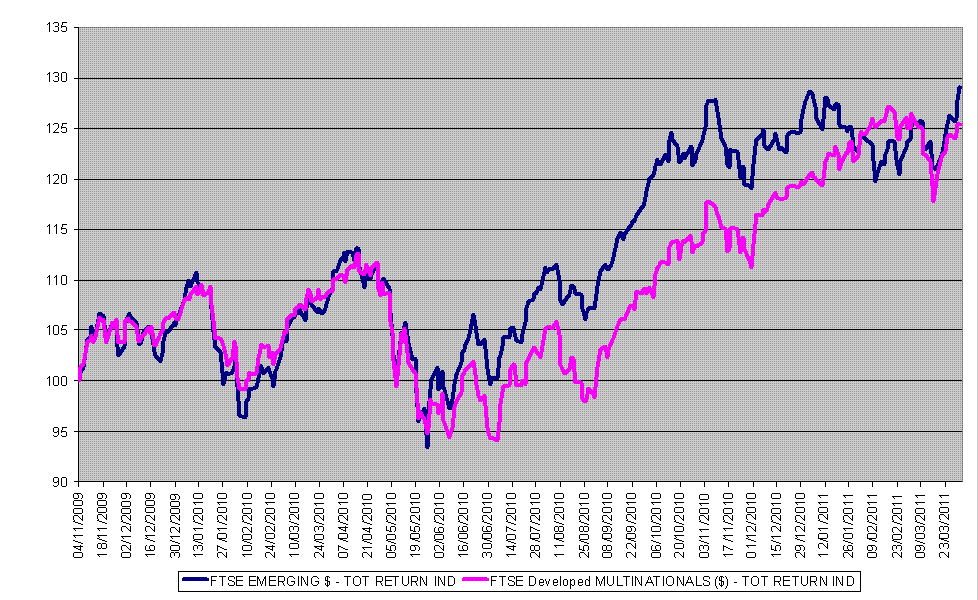
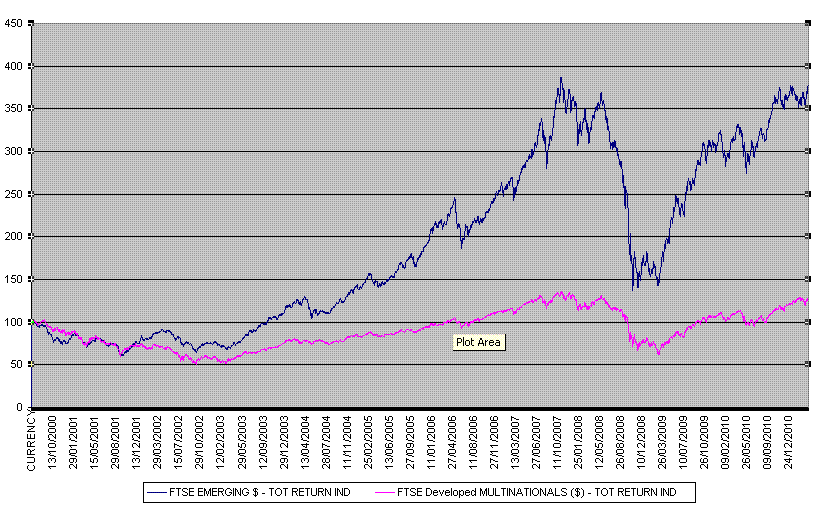
beyondbrics has plotted a chart to test the theory, using the FTSE emerging market index and the FTSE developed multinationals index, which includes multinationals that derive 30 per cent or more of their revenues from outside their home economic region, to see whether returns are correlated and which index yields higher returns
What we’ve found is that if you plot a chart to begin in January 2009 there is indeed strong correlation between the FTSE EM and FTSE developed multinational index.
(see Chart 1 below)
But if we rebase the chart to begin at the start of 2000, we get a very different picture and investing in emerging markets looks to have been the smarter choice. (see Chart 2 below)
And what about the future? Investors are better off going to a fortune teller for that kind of information.
More and more Americans are dabbling in currency trading and losing in spectacular fashion. Experts say the structure of the currency market makes it hard for amateurs to beat the house.
By Nathaniel Popper, Los Angeles Times
April 3, 2011
Reporting from New York
Advertisement
Dorothy Ouma began trading foreign currencies after seeing a TV commercial touting it as a way to make extra money, something she could use as a single mother raising three children.
"The ads made me think, 'This is easy,'" said Ouma, 52, an administrator with the Grand Prairie, Texas, police department.
Ouma used her credit card to fund an account with an online currency broker. Within a few weeks of swapping dollars for yen and euros, she said, her $3,000 of borrowed money was gone.
"Even if you make money for a little while, eventually you just end up losing," she said.
Ouma made two mistakes: investing on credit and trying to make a buck by predicting changes in currency exchange rates, something best left to professionals, according to personal finance experts. But she has plenty of company.
An estimated 615,000 Americans are dabbling in foreign currency trading, encouraged by advertising from the two biggest U.S. brokers, FXCM Inc. and Gain Capital Holdings Inc., both based in New York.
Combined, FXCM and Gain have about 260,000 accounts, a third of them in the U.S.
These customers are losing money in spectacular fashion.
At FXCM, 75% to 77% of customers lost money each quarter last year, according to newly required disclosures to the Commodity Futures Trading Commission. At Gain, which operates through http://www.forex.com, the number of unprofitable customers hovered between 72% and 79% every quarter last year, according to its filing.
Lots of leverage, lots of turnover
As if those statistics weren't scary enough, the rules of currency trading allow investors to leverage every dollar they bet on a 50-to-1 ratio. This allows them to bet money they don't have — a tactic that can boost profits but also losses.
The losses have triggered recent lawsuits and regulatory scrutiny — but haven't stopped the swift growth of the industry, which barely existed a decade ago. Gain and FXCM went public on the New York Stock Exchange last December.
Executives with both firms say that they simply provide a conduit for people who want to trade currency, and that customers are given full disclosure of the risk.
"The majority of people today are on a quarterly basis not doing well," Drew Niv, FXCM's chief executive, acknowledged in an interview. "There's lots of education showing, 'Here's how to do it right.' … Do most people heed the advice? No, of course not."
Trading experts, however, argue that the companies use aggressive advertising to lure inexperienced investors into an unusually opaque market.
"The business model for forex trading is to burn the customer and then find another one," said Larry Harris, a USC professor and the former chief economist at the Securities and Exchange Commission.
FXCM's own statistics show that its customer turnover is about four times higher than that of an ordinary retail stock broker. Gain does not release turnover statistics, but its securities filings show that most of its customers at the end of last year were different from the ones it started with, also suggesting high turnover.
'At the mercy of the dealer'
Experts say the unusual structure of the currency market makes it hard for amateurs to beat the house.
With stocks, brokerages typically send customer orders out to be executed at an independent exchange and charge a set commission for each trade, no matter whether the customer wins or loses.
That's not the case in foreign currency markets. Because there is no centralized currency exchange, the brokers must fill customer orders themselves. This enables them to make money in two ways.
The first is by buying a currency at one price and selling it at a higher price — netting the so-called spread between the two. Unlike the set commissions charged by stockbrokers, these spreads can be set at whatever level the currency broker chooses.
The second way the broker-dealers make money is by sitting on the opposite side of every customer trade, like a blackjack dealer sitting across from a gambler.
For instance, suppose a customer buys 10,000 euros at $1.45 each and sells them back to the broker at $1.50 apiece. That would net the customer a profit of $500 — and give the currency dealer a loss of $500.
More commonly, however, it's the customers who lose out on these transactions, despite required disclosure statements that warn investors: "Your dealer is your trading partner, which is a direct conflict of interest."
Gain ended up making an average of $2,913 from every active trader it had last year, even though the average customer account contained only $3,000, according to the company's financial data.
FXCM made $2,641 for every active trader, while the average customer had $3,658.
When foreign currency trading got going in the 1970s it was accessible only to banks and institutions. As a result, regulators allowed banks to swap currencies among themselves rather than on the type of regulated exchange that was standard for stocks, futures and commodities.
In the 1990s, a few fly-by-night companies began trading currencies for amateur investors, without any regulatory oversight.
Online trading technology exploded, and in 2000 Congress put currency brokers under the CFTC's watch. But there is still no transparent exchange for currencies, so brokers also serve as dealers for their customers. The lack of an exchange, where data on prices and trades would be stored, also makes it harder for customers to determine whether they are getting a good price from their dealer.
"Once you have things that are done off exchange you are pretty much at the mercy of the dealer — telling you what the price is, telling you what you owe," said Michael Greenberger, a University of Maryland professor and former head of trading and markets at the CFTC. "Anybody I cared about — I'd say, 'Stay away from this.'"
An opaque market riddled with scams
The unusual structure of the market has made it a popular target for outright fraud. In a typical scam, clients are drawn in by advertisements promising big returns, but once the deposits are in, the company disappears.
CFTC Chairman Gary Gensler recently said it was the "largest area of retail fraud" his agency oversees.
Gensler's agency has tried to rein in the problems with a set of rules for currency trading that went into effect last October. These required the brokers to be more transparent but did not change the fundamental setup of the market.
The CFTC has delegated most of its regulatory responsibilities to the National Futures Assn., an agency established by Congress that is funded by the brokers themselves.
NFA spokesman Larry Dyekman said his group is trying to do more active supervision, but he said the NFA had a difficult job. "It's not as transparent" as other trading markets, he said.
Still, the NFA fined Gain $459,000 last October after issuing a complaint that detailed what it called abusive practices "that benefited Gain to the detriment of its customers."
The NFA complaint alleged that Gain set its trading program to allow certain trades when they went in Gain's favor, while not allowing the same trades when they went in the customer's favor, costing clients $169,502 during one three-month stretch in 2009.
The NFA also alleged that another Gain practice caused $425,000 in customer losses over three days.
Gain CEO Glenn Stevens said that the settings affected only a small portion of customer trades and that they "were since very quickly rectified and changed."
FXCM has tried to set itself apart from Gain and most other brokers by creating a system that it says removes the conflict of interest. FXCM is still always on the other side of every customer trade, but the company says that it takes trades only if it can immediately move them to outside banks so that FXCM does not stand to benefit from its customers' losses.
"Most people felt the market was less fair than the one for [stocks] — and that is a fair observation, historically, for sure," Niv said. "That is why we are trying to go public and differentiate from the pack."
FXCM has faced many of the same complaints as Gain, however, including in a lawsuit filed in federal court in New York in February by an Oklahoma man who claims to have lost more than $150,000.
FXCM operates "a platform predicated upon deceit and trickery that systematically looted the accounts of customers," and has used this to take "hundreds of millions of dollars from hundreds of thousands of unsuspecting customers," according to the suit, which seeks class-action status.
Niv said the suit is a form of "extortion" and "an utter fabrication."
Aside from concerns about fraud, market experts warn that the unusual rules of the foreign currency game make it an unsuitable investment strategy for anyone who cannot afford to lose money.
The leverage ratio of 50 to 1 was taken down by the CFTC from 100 to 1 a few years ago, but it is still 25 times as much leverage as retail stock traders are allowed to use, and many times more than what most professional currency traders employ.
"When things change, it's a sudden fall off the cliff," said Aswath Damodaran, a finance professor at New York University.
No limits on who can place a bet
Finally, while some types of risky investments, such as hedge funds, are restricted to so-called sophisticated investors, there are no limits on who can get involved in foreign currency trading.
FXCM allows customers to start trading with as little as $50, and its ads target novices — a recent banner on CNBC's website said, "Trading the Euro can be EASY! See how with a FREE PRACTICE ACCOUNT."
Both companies offer practice accounts designed to help customers learn how foreign currency trading works, but these practice accounts operate under simpler rules than the real accounts.
In another marketing effort, Gain and FXCM teamed up to sponsor a weekly show on CNBC about foreign exchange, which debuted Feb. 25. The show, "Money in Motion," hypes the wonders of currency trading. "Now, more than ever before, currencies are emerging as the everyday investor's weapon of choice in the battle to gain an edge," marketing material for the show said.
A CNBC spokesman pointed to the standard disclaimer that runs with the show and noted that the network has the most affluent and educated viewers of any cable network.
Ouma, the Texas woman who lost $3,000, began trading after seeing an ad during a local newscast. She said that when she was trading with FXCM, a number of problems cropped up whenever she was making any profit, resulting in sudden big losses.
"They always had tricks to take my money," Ouma said.
FXCM said it would not comment on individual customers. After The Times contacted the company, however, Ouma said FXCM called her and offered to refund her losses.
For some people, of course, the risk is part of the thrill.
Jeff Goodwin, a 23-year-old Internet entrepreneur in New Hampshire, said that after a few years of losing money in the market, he recently found a strategy that has been turning a steady profit. But the potential for big losses is what makes it fun.
"Is it gambling? Yeah," Goodwin said. "You easily get addicted."
The hedge fund industry's strong rebound from the credit crisis has prompted investors to ask whether some funds have grown too large and inflexible to keep delivering bumper returns for which the sector is famous.
The growth of big funds -- helped by strong returns during the credit crisis and some clients' belief that risks are lower than in start-ups -- helped push industry assets to $1.92 trillion at end-December, close to the all-time high in 2008, according to Hedge Fund Research.
However, with the growth of big funds has come the old question of whether they could be stuck if another crisis hits, whether liquidity forces them into less profitable markets and whether their prized trade ideas will be discovered by rivals.
"By definition a supertanker can't be as nimble as a speedboat," said Ken Kinsey-Quick, fund of hedge fund manager at Thames River, part of F&C, who prefers to invest in funds below $1 billion in size.
"They won't be able to respond to market conditions, especially as markets become illiquid. They can't get access to smaller opportunities, for example a new hot IPO coming out of an investment bank -- if everyone wants it then you'll only get a few million dollars (worth)."
Funds betting on bonds and currencies, and CTAS -- which play futures markets -- in particular have grown strongly.
Brevan Howard's Master fund, which is shut to new clients, has grown to $25 billion after gaining around 20 percent in 2008 and 2009, while Man Group's computer-driven AHL fund is now $23.6 billion, helped by a 33 percent return in 2008.
Meanwhile, Bluecrest's Bluetrend fund, which has temporarily shut to new investors in the past, has nearly tripled in size since the end of 2007 to $8.9 billion after a 43 percent gain in 2008. And Louis Bacon's global macro firm Moore Capital has grown to $15 billion after a good credit crisis.
LIQUIDITY
While capacity varies between strategies, some clients worry about the time it can take a big fund to sell a security in a crisis. Even in today's markets a small fund can sell a position with one phone call while it may take a big fund a morning.
"It's even more difficult than before the crisis to turn around your portfolio. Liquidity in the market is not back to where it was. A fund of $20 billion in 2007 was easier to manage than it is now," said Philippe Gougenheim, head of hedge funds at Unigestion.
"Because of poorer liquidity you're paying a higher price to get in and out of positions. Given the current political and macroeconomic environment it's important to be able to turn around your portfolio very quickly."
Big funds may find it hard to keep trades secret long enough to implement them, especially when buying or shorting stocks.
One hedge fund executive told Reuters his firm's flagship fund, once several billion dollars in size, used to break up trades between a number of brokers or initially sell a small amount of the stock -- which could give the market the impression it planned to sell more -- before buying heavily.
Meanwhile, Unigestion's Gougenheim said fixing a meeting with managers of big funds can be hard -- if a manager runs most of the money they can be hard to pin down, while if they run a small part it can be hard to find out who runs the rest.
"NOT AN ISSUE"
However, fund executives say markets are liquid enough.
"Size is not an issue whatsoever," Nagi Kawkabani, founding partner at Brevan Howard, told Reuters, adding that the fund's gross exposure -- the sum of bets on rising and falling prices -- was lower than at the start of 2008.
"Markets are much bigger and deeper than they were five or 10 years ago." Brevan would return money to clients if funds became too big, although there are no plans at present, he said.
Thames River's Kinsey-Quick said big CTAs could find it hard to trade smaller markets, although they may take small bets in these markets to show clients they can play them.
An AHL spokesman said size was "a major advantage... It gives us great purchasing power with brokers which translates into tighter spreads whilst paying pay lower commissions."
Hedge funds are one of my favorite topics. One of the best jobs I ever had in the pension industry was working with Mario Therrien's group at the Caisse de dépôt et placement du Québec, allocating to external hedge funds. I was the senior analyst responsible for analyzing and covering directional hedge funds: Long/Short equity, short sellers, global macro and commodity trading advisors (CTA) funds. It was a fun job because I got to meet a lot of managers from different backgrounds and talk markets with them. I also learned about their strategies and the differences between directional and market neutral alpha strategies.
No matter who was sitting across the table from me, I never shied away from asking tough questions on their organization, operations, investment process and risk management. Allocating money to hedge funds isn't a job for the shy and timid; you got to be able to grill them when you need to. But I also listened carefully to their responses, paying close attention to how they addressed difficult periods. The best hedge fund managers aren't uncomfortable talking about periods where they lost money and how they coped. Anyone can talk up a great game when they're making money but very few managers have the self assurance to talk about the difficult periods. For me, those discussions were crucial and told me a lot about the manager, and more importantly on the organization's culture and depth. The toughest part of that job was the constant traveling which takes its toll.
Preqin research shows that the number of public pension systems investing in hedge funds has increased significantly over the past four years. There are now 295 public pension plans worldwide known to be allocating to hedge funds, up from 196 in 2007. The mean allocation to the asset class has also grown in the same period from 3.6% to 6.6%; it is now one percentage point higher than the average private equity allocation of these investors. Public pension systems and hedge funds:
Pension systems generally invest in hedge funds for capital preservation and portfolio diversification purposes.
They seek absolute returns of 6.1%, lower than the average expectations of other investor types which stand at 7%.
Funds of hedge funds are popular with pension funds – four-fifths of public pension systems that made their first hedge fund investments in 2010 did so through multi-manager allocations.
70% of all pension funds investing in hedge funds have funds of funds commitments in their portfolios.
The top 10 public pension system investors in hedge funds have a collective $836bn in AUM
Public pension systems’ hedge fund portfolio performance:
As of Q2 2010, hedge funds showed positive one-year returns.
Hedge funds have outperformed listed equities over a three- and five-year period.
Hedge funds have outperformed public pension funds’ average annualized return expectations of 6.15% by producing average returns of 9.8%.
Despite negative returns over a three-year timeframe, public pension system investors have increased their allocations to the asset class; this is in stark comparison to the many high-net-worth counterparts that have reduced their hedge fund commitments during the period.
You can download the full Preqin report by clicking here. I'm not shocked to see public pension plans allocate aggressively into alternatives, which include hedge funds, private equity funds, real estate funds and infrastructure funds. Why are they doing this? Many plans are underfunded so to make up for the shortfall, they're reducing their fixed income allocation and going into hedge funds and other alternatives. As the big beta boost in the stock market matures, pension funds are focusing more on alpha strategies that can deliver returns in turbulent markets. Also, many pension funds have investment policies that limits the amount of leverage they can take internally, which is why they allocate to external hedge fund and private equity managers to increase their leverage.
Not surprisingly, the bulk of the assets have been going to liquid hedge fund strategies like global macro, CTA and L/S equity. It was two years ago when I wrote a comment on the death of highly leveraged illiquid strategies. Nothing has changed; they're still dead. Post 2008, there is a premium for liquid alpha strategies and most of the smarter institutional investors are managing their liquidity risk very carefully.
Some public pension funds know what they're doing, scoring big with hedge funds. I cringe, however, when I read that Preqin finding that four-fifths of public pension systems made their first hedge fund investments in 2010 did so through multi-manager allocations and that 70% of all pension funds investing in hedge funds have funds of funds commitments in their portfolios. I'm not a big fan of fund of funds which add another layer of fees. If by "multi-managers" Preqin meant mutli-strategy hedge funds, then that's fine (standard 2 and 20 fee structure). Keep in mind, fund of hedge funds were facing extinction in December 2008. It's amazing how fast things have turned around.
It's true, the top hedge fund managers know about making money, generating huge brokerage commissions that gives them access to some of the best investment ideas Wall Street generates. But even the best hedge fund managers can experience a serious hiccup (witness Philippe Jabre's recent $300 million Japan mistake). And I get really nervous when I read that GAM just launched another retail fund of funds. Just tells me things are getting frothy again in hedge fund land, but it also confirms my suspicion that we're heading towards another 1999, as all this liquidity finds its way into stocks, bonds, currencies and commodities.
Have hedge funds grown too large? Maybe, we'll see during the next crisis, but I still favor liquid over illiquid alternatives. I would however look at allocating more to market neutral funds in this environment but be careful with the leverage they're taking. Moreover, institutional investors, especially those with little or no experience with hedge funds, should strongly consider the merits of a managed account platform that allows them to control operational and liquidity risk. The last thing you need is to invest in some fake hedge fund that defrauds you.
***UPDATE***
An industry expert shared these comments with me, which I share with my readers:
I agree with you, favoring liquid strategies vs illiquid ones. The biggest problem with illiquidity is that investors were not getting paid for providing liquidity to others. At the very least, if you take the risk of doing it, get compensated for it!!!
In terms of who can use managed account platforms (MAP), I believe it applies to all kinds of investors, not only to those with little or no experience. What we’re seeing this year is the very large and very experienced going to MAP in order to better control their risks. The “cash on steroids” approach. Finally, the size debate is a hot topic, with arguments going both ways. My take is the following: returns will necessarily diminish with the size of the HF. You can have a Bridgewater one year, but that’s just one exception rather than the norm. On the other hand, I do not agree that they are getting too big for the financial system. Goldman is the largest HF, they have permanent capital (or I should say they act like if they have permanent capital…) and their size dwarfs any hedge fund. I would be much more worried about Goldman, vs the others who manage their liquidity risk much more carefully now.
I thank him for sharing his insights with me and letting me post them here. He also sent me this Infovest21 article, which discusses how large US pension funds are increasing direct allocations to hedge funds and some are using fund of funds as subadvisors to facilitate knowledge transfer so the pension may eventually take on the internal management of the hedge fund program.
While emerging markets actually provided a safe haven during the equity market's most recent sell off, not all emerging markets have been performing equally. While the BRIC countries have become synonymous with emerging markets, most of the BRICs have been lagging. In US Dollar adjusted returns, the only BRIC that has outperformed the United States over the last year is Russia, which has rallied more than 28%.
The founder of UK based hedge fund firm Odey Asset Management, Crispin Odey, is out with his latest market commentary and investment outlook. Penned on the 28th of February, Odey writes on the slightly tangential, yet increasingly talked about topic of farming and agricultural commodities.
We've detailed how legendary investor Jim Rogers is bullish on agriculture and has also bought farmland. Also, the now famous subprime short-seller Michael Burry also bought farmland. While these well-known investors focus on arable land, Odey's recent commentary expresses concern regarding agricultural commodities and supply/demand imbalances.
Here's Crispin Odey's outlook:
"This is always the time of year when my farming friends ring me up every day to ask 'should they be selling forward their harvest?' The truth is that at this time of year they have little to do other than worry about it, and because they worry they are always early sellers. Like everyone, they are risk averse. By now with the harvest less than six months away, they are probably 65% pre-sold and yet they watch the price rising and falling and of course on weak days they kick themselves for not selling more.
In my hedge fund we are also forced to get involved. We are shareholders in a station in Australia which this year has grown over 23,000 acres of cotton, and plans to grow 25,000 acres next year. Cotton has nearly tripled in price in eighteen months and it is no surprise to find that we sold this year's harvest, which is just about to start, at half the current prices. Why? Because we had sold 2/3 of our crop forward by November of last year. We were the lucky ones because our neighbours further down the Darling River lost most of their crop, thanks to the flooding, and the rise in the price from $100 to $220 per bushel was nothing more than them covering that shortfall. Like many people, they hated taking a loss and the same conservatism that had led them to sell forward, led them to sit and hope that the price would come down before delivery in April. Many of these farmers face bankruptcy, in the best year for cotton in 30 years. This year the farm will make a 30% return on our investment made nearly four years ago. If prices hold into next year we would almost earn what we paid for the farm, in one year. In other words prices are very unlikely to hold!
However, if you look generally at where we are globally, soft commodities are suffering from the same kind of demand/supply imbalance that has driven steel production worldwide to go from 580 million tons to over 1350 million tons in less than a decade. Taking grain production last year globally, the world produced 2.179 billion cubic tons, down 2.4% from the previous year, but up from 1.87 billion cubic tons, produced in 2000. However, consumption was 2.235 billion cubic tons and inventories in thenorthern hemisphere are now 27% below where they were in 2000 and down 15% in a year to 425m tons. The importance of China can't be overstated. The USA increased exports of corn, soy beans, wheat and cotton by 18% last year, but China's share of exports rose by 34%.
Over ten years China's urban incomes have risen threefold; their agricultural incomes have doubled. If you believe like I do that China's growth will not falter until their current account deficit goes negative, my farming friends may have to devise an alternative pastime after the shooting season ends in January, to selling their harvest early.
The corollary of all of this is of course that the cost of living is rising for the developing world at an alarming rate. Most of these countries exacerbate their problems by subsidising food prices. Investors must expect that revolutions, sparked by bread riots, will be part of their diet, for as long as China's demand continues to grow."
Shrinking Margins Make Stocks’ Cheapness Just A Mirage
Thinner margins got WAG whacked Tuesday
Profit margins are a tick away from all-time highs and are creating the impression of cheap equity valuations. That impression is a mirage, however, because today’s generous margins are destined to shrink.
I first wrote about this in January 2008, and this is an update to that article. All I had to do was to update a chart and the numbers in the article and add a few comments – all of them are underlined.
Stocks are allegedly cheap now, at 15.7 times 2010earnings. And they are cheap by historical standards. Only 10 years ago, their price/earnings ratios were double today’s; they are even cheaper if you compare their forward (2011) earnings yield of 7.3% to the 10-year Treasury yield of3.40%. They are cheap, cheap, cheap!
Or so we’ve been told.
Unfortunately, the cheapness argument falls on its face once we realize that pretax profit margins are hovering close to an all-time high of 13.3% (the all-time high was 13.9% in 2007), almost 58% above their average of8.4% since 1980.
Once profit margins revert to their historical mean, the “E” in the P/E equation will decline. If the market made no price change in response, its P/E would rise from 15.7 to 24.9 times trailing earnings.
Many disagree that profit-margin reversion will take place. Here are their most common arguments, and some food for thought on why this supposed common sense doesn’t translate to sensible logic.
Who said that margins have to revert to a mean; why can’t they just remain high?
“Profit margins are probably the most mean-reverting series in finance, and if profit margins do not mean-revert, then something has gone badly wrong with capitalism. If high profits do not attract competition, there is something wrong with the system and it is not functioning properly.” – Jeremy Grantham
Profit margins revert to the mean not because they pay tribute to mean-reversion gods, but because the free market works. As the economy expands, companies start earning above-average profits. The competition reacts to fat margins like bees sensing sugar water. They want some, so they fly in and start cutting into these above-average margins.
What about the billions of dollars U.S. companies poured into technology – weren’t they supposed to make their operations more efficient and bring higher profit margins?
Those billions of dollars did not go to waste; companies are more productive now than ever before. Efficiency gains stemming from productivity were a source of competitive advantage and higher margins when access to proprietary technology was a competitive advantage. For example, Wal-Mart’s rise in the retail industry was achieved through a very efficient inventory-management and distribution system that passed cost savings to consumers and drove less-efficient competitors out of business.
Today, however, that same – or even better – technology is available off-the-shelf to retailers like Dollar Tree and Family Dollar, whose outlets are about the same size as a couple of Wal-Mart restrooms put together. Oracle or SAP will gladly sell state-of-the-art distribution/inventory software systems to any company able to spell its name correctly on a check. Increased productivity didn’t and won’t bring permanently higher margins to corporate America – the consumer is the primary beneficiary of lower prices. If profit margins didn’t respond as they do, Wal-Mart’s net margins would be 25% today, not 3.5%.
Over the past 70 years, growth in corporate earnings and GDP haven’t differed significantly. On the other hand, there has been a permanent benefit from increased operating efficiency: It lets companies hold less inventory and adjust more quickly and precisely to changes in demand. This has led to less volatile GDP.
Shouldn’t average profit margins be higher now, as the U.S. economy has transitioned from an industrial (low-margin) economy to a service (higher-margin) economy?
It is not as much of a change as we might think. In 1980, services represented about 51.3% of GDP. After 30 years and a lot of changes like outsourcing, services have increased to 65.3% of GDP. If we assume that the service sector has double the margins of the industrial sector (a fairly conservative assumption), increases in the service sector should have boosted overall corporate margins by about 40 to 80 basis points above their 30-year average – to between 8.8% and 9.2%, but still far below today’s 13.3% margin. Thus, if we adjust corporate margins to reflect the transformation toward a service economy, corporate profit margins are still 45% above their long-term mean.
Shouldn’t globalization allow U.S. companies to increase margins?
A larger portion of U.S. companies’ profits is coming from overseas than ever before. However, globalization is a double-edged sword – U.S. companies are expanding and will continue to expand overseas and capitalize on new opportunities. But as the world flattens, they also face new competition at home and abroad. For example, Motorola – a company that used to represent American might in the telecommunications arena – has been marginalized in the U.S. and around the world by companies whose names we didn’t recognize 15 years ago – Finland’s Nokia and South Korea’s Samsung. (It’s very interesting how much the smartphone industry has changed in three years: Apple, a company I did not even mention in my 2008 article, has transformed the industry. Motorola, which was almost dead then, is coming back to life. Nokia is becoming irrelevant very quickly, and LG and HTC are important players.)
Although Wal-Mart is rapidly expanding overseas, it will soon face a new breed of competition. U.K. retail giant Tesco recently entered the American market (Cisco Systems has been successful in Asia, but its home turf has been attacked by the Chinese company Huawei.) U.S. companies may get a larger portion of their earnings from overseas (the weak dollar will help), but they’ll have to fight to defend home turf.
International expansion doesn’t guarantee fatter margins; quite the opposite: We are facing competition from countries such as Korea and China that may be more concerned with increasing market share, even at the expense of short-term profitability.
Higher oil prices are here to stay, so maybe multiyear higher margins in the energy sector are here to stay as well.
This would be the case if energy companies sold their products to customers in another galaxy where somebody else bore all the costs of high-energy prices. Petroleum products are consumed by corporations and individuals. The benefits of higher profit margins to the energy sector are achieved at the expense of lower margins for companies that consume their products – which is the rest of the corporate world, to varying degrees.
Today’s stock valuations are a lot higher than it appears if you normalize earnings to lower profit margins. And while it’s hard to tell when earnings will embark on a fateful journey to their historic mean, competitive forces will make that happen sooner than later. Earnings will either decline or grow at much slower pace than GDP.
Companies that don’t have a sustainable competitive advantage will not be able to keep their competition at bay, and will face margin compression, along with lower earnings growth or declining earnings. Look at your portfolio: Can the companies whose margins are hitting all-time highs sustain them?
P.S.
Robust (above-average) earnings growth from the depth of a recession creates a false appearance, usually reflected in forward earnings estimates, that earnings can and will grow at a faster rate than the economy for a long period of time – but they don’t (see chart below, the growth of $1 of earnings and GDP from 1950 to 2010). For earnings to grow at much higher rate than the economy (GDP) for a long time, profit margins have to keep expanding, and as I’ve discussed in the past, capitalism (i.e. competition) doesn’t allow that to happen.
"Two problems are upon us at once: short-term stimulus that is unaffordable over the long run and runaway entitlements that must be reined in. But restoring fiscal sanity will be bad for the economy and financial markets. What Treasury official or politician would want the cash spigot turned off before a recovery is certain? Recipients of government handouts – a large percentage of the population – would grumble at the termination of policies that offer them outsized benefits. So prepare for a chorus of "but not yet.” One already sees this in editorials and commentaries, such as the ones saying it's time to close down bankrupt Fannie Mae and Freddie Mac, but not yet, because doing so would harm the still-weak housing market. There will never be a good time to end housing support programs, reverse quantitative easing policies, end fiscal stimulus, or reduce massive budget deficits – because doing so will restrict growth and depress share prices. Nor will there be a good time to cut entitlement programs or to solve Social Security or Medicare underfunding. All will agree the stimulus cannot go on forever, that excessive entitlements must be reined in, “but not yet."
The financial collapse of 2008 highlighted our national predicament. The sudden decline in consumer activity that followed the plunges in the housing and stock markets represented a reasonable – indeed a desirable – response to overindebtedness. Yet the federal government saw this well-advised retrenchment as cataclysmic, because the national economy had grown dependent on our living beyond our means. The imagination of our financial leaders remains so shallow that their response to a crisis caused by overleverage and excess has been to recreate, as nearly as possible, the conditions that fomented it, as if the events of 2008 were a rogue wave of financial woe that can never recur. It is only in Fantasyland that the solution to vastly excessive debt is more debt and the answer to overconsumption is less saving and more spending. Worse still, we have yet to see a serious assessment by policymakers of the causes of the 2008 financial market and economic collapses so that we might take action to ward off a repeat performance. The government’s knee-jerk response to contraction was to prop up economic activity by any and every means possible; the hole in consumer activity had to be materially repaired on the government tab. While Treasury Secretary Timothy Geithner ingenuously professes a belief that the U.S. will never lose its AAA rating, Moody's recently warned that, absent a change, a downgrading could be just around the comer. Or, in the words of David Letterman, "I heard the U.S. debt may now lose its triple-A rating. And I said to myself, well who cares what the auto club thinks."
Most of us learned about the Great Depression from our parents or grandparents who developed a "Depressionmentality," by which for decades people shunned leverage, embraced thrift, and thought twice before quitting their secure jobs to join risky ventures. By bailing out the economy rather than allowing the pain of the economic and market collapses to be felt, the government has endowed our generation with a "really-bad-couple-of-weeks-mentality": no lasting lessons are learned; the government endlessly intervenes in the economy, and, ironically, the first thing to strongly rebound from the 2008 collapse isn't jobs or economic activity but speculation.
Benjamin Graham's margin-of-safety concept – to invest at a sufficient discount so that even bad luck or the vicissitudes of the business cycle won't derail an investment – is applicable to the economy as a whole. Bridges intended for ten-ton trucks are overbuilt by engineers to hold vehicles of 30 tons. Responsible investors assume their best judgments will sometimes go awry and insist on bargain purchases that allow room for error. Likewise, an economy built with no margin of safety will eventually implode. Governments that run huge deficits, promise entitlements that will be next-to impossible to deliver, and depend on the beneficence of foreigners to stay afloat inevitably must collapse – perhaps not imminently but eventually, as Greece and Ireland have recently discovered.
It is clear, both in the financial markets and in government policy, that no long-term lessons have been drawn from the events of 2008. A friend recently posited that adversity is valuable not for what it teaches but for what it reveals. The current episode of financial adversity reveals some unpleasant truths about the character and will of our country and its leaders, and offers an unpleasant picture of the future that awaits, unless we quickly find a way to change course.
The Demonization of Short-Seller
While we rarely sell securities short – both because of the degree of execution difficulty and theoretically unlimited risk compared to limited potential return – we do believe that short-selling serves a vitally important function. Markets, of course, fluctuate; driven by human emotion, greed, and fear, they can reach significantly overvalued levels. This is bad, both because it can induce some who cannot afford losses to speculate, and because it can lead to an improper allocation of society's resources. The recent housing bubble illustrates the problem: excessive home prices led to excessive home building, eventually resulting in a price collapse, large loan losses, and great personal hardship. In addition, the decline that follows periods of market overvaluation is bad for the broader economy, for confidence, and for rational decision making; it also frequently triggers government intervention in markets, with all of its inevitable distorting effects. Just as value buyers can dampen downside volatility, short-sellers can dampen the upside excesses. They don't actually change the eventual outcomes, just help us get there sooner. This makes short-sellers unpopular, as the uninformed masses enjoy high and rising securities prices for the short-term profits they produce, without understanding the societal costs of the future reversal. The less you understand valuation, the more that overvaluation seems like a free lunch – which of course it isn't.
From our experience, much long-oriented analysis is simplistic, highly optimistic, and sloppy. Short-sellers, by going against the long-term tide of economic growth and the short-term swells of public opinion and margins calls, are forced to be crackerjack analysts. Their work product is usually top-notch and needs to be. Short-sellers shouldn't be reviled or banned; most should be celebrated and encouraged. They are the policemen of the financial markets, identifying frauds and cautioning against bubbles. In effect, they protect the unsophisticated from predatory schemes that regulators and enforcement agencies don't seem able to prevent.
Moreover, the short-seller who is fundamentally wrong, who mistakenly sells short an undervalued security, will lose money and, if the pattern continues, will eventually go broke. Short-sellers, like long-only buyers, need to be right more than they are wrong; when they are right, their actions are socially beneficial, not harmful. The only exception to this point, the only danger short-sellers pose to society, is when, in the equivalent of yelling "fire" in a crowded theatre, they spread false rumors that prevent a company that needs regular financing (such as brokerage firms) from being funded. Then, their predictions become self-fulfilling prophecies, enabling them to profit, whether or not they were fundamentally correct; they may actually be able to change the outcome. Yet, even in this situation, one may wonder whether any company – or highly leveraged government, for that matter – should employ a funding model that depends on perpetual access to the capital markets, which are notoriously fickle, volatile, subject to the influence of malicious gossip, and short-term oriented. In any event, mechanisms such as the uptick rule and rules against market manipulation already exist to prevent such misbehavior by short-sellers.
A Framework for Investment Success
Two elements are vital in designing an investment approach for long-term success. First, answer the question, ''what's your edge?" In highly competitive financial markets, with thousands of very smart, hardworking participants, what will enable you to reliably outperform the field? Your toolkit is critically important: truly long-term capital; a flexible approach that enables you to move opportunistically across a broad array of markets, securities, and asset classes; deep industry knowledge; strong sourcing relationships; and a solid grounding in value investing principles.
But because investing is, in many ways, a zero-sum activity in which your returns above the market indices are derived from the mistakes, overreactions or inattention of others as much as from your own clever insights, there is a second element in designing a sound investment approach: you must consider the competitive landscape and the behavior of other market participants. As in football, you are well-advised to take advantage of what your opponents give you: if they are defending the run, passing is probably your best option, even if you have a star running back. If scores of other investors are rigidly committed to fast-growing technology stocks, your brilliant tech analyst may not be able to help you outperform. If your competitors are not paying attention to, or indeed are dumping, Greek equities or U.S. housing debt, these asset classes may be worth your attention, regardless of the currently poor fundamentals that are driving others' decisions. Where to best apply your focus and skills depends partially on where others are applying theirs.
When observing your competitors, your focus should be on their approach and process, not their results. Short-term performance envy causes many of the shortcomings that lock most investors into a perpetual cycle of underachievement. You should watch your competitors not out of jealousy, but out of respect, and focus your efforts not on replicating others' portfolios, but on looking for opportunities where they are not.
Much of the investment business is centered around asset-gathering activities. In a field dominated by a short-term, relative performance orientation, significant underperformance is disastrous for retention of assets, while mediocre performance is not. Thus, because protracted periods of underperformance can threaten one's business, most investment firms aim for assured, trend-following mediocrity while shunning the potential achievement of strong outperformance. The only way for investors to significantly outperform is to periodically stand far apart from the crowd, something few are willing or able to do.
In addition, most traditional investors are limited by a variety of constraints: narrow skill-sets, legal restrictions contained in investment prospectuses or partnership agreements, or psychological inhibitions. High-grade bond funds can only purchase investment-grade bonds; when a bond falls below BBB, they are typically forced to sell (or think that they should), regardless of price. When a mortgage security is downgraded because it will not return par to its holders, a large swath of potential purchasers will not even consider buying it, and many must purge it. When a company omits a cash dividend, some equity funds are obliged to sell that stock. And, of course, when a stock is deleted from an index, it must immediately be dumped by many. Sometimes, a drop in a stock's price is reason enough for some holders to sell. Such behavior often creates supply-demand imbalances where bargains can be found. The dimly lit comers and crevasses existing outside of mainstream mandates may contain opportunity. Given that time is often an investor's scarcest resource, filling one’s in-box with the most compelling potential opportunities that others are forced to or choose to sell (or are constrained from buying) makes great sense.
Price is perhaps the single most important criterion in sound investment decision making. Every security or asset is a "buy" at one price, a “hold” at a higher price, and a "sell" at some still higher price. Yet most investors in all asset classes love simplicity, rosy outlooks, and the prospect of smooth sailing. They prefer what is performing well to what has recently lagged, often regardless of price. They prefer full buildings and trophy properties to fixer-uppers that need to be filled, even though empty or unloved buildings may be the far more compelling, and even safer, investments. Because investors are not usually penalized for adhering to conventional practices, doing so is the less professionally risky strategy, even though it virtually guarantees against superior performance.
Finally, most investors feel compelled to be fully invested at all times – principally because evaluation of their performance is both frequent and relative. For them, it is almost as if investing were merely a game and no client's hardearned money was at risk. To require full investment all the time is to remove an important tool from investors' toolkits: the ability to wait patiently for compelling opportunities that may arise in the future. Moreover, an investor who is too worried about missing out on the upside of a potential investment may be exposing himself to substantial downside risk precisely when valuation is extended. A thoughtful investment approach focuses at least as much on risk as on return. But in the moment-by-moment frenzy of the markets, all the pressure is on generating returns, risk be damned.
What drives long-term investment success? In the Internet era, everyone has a voluminous amount of information but not everyone knows how to use it. A well-considered investment process – thoughtful, intellectually honest, teamoriented, and single-mindedly focused on making good investment decisions at every turn – can make all of the difference. Investors with short time horizons are oblivious to kernels of information that may influence investment outcomes years from now. Everyone can ask questions, but not everyone can identify the right questions to ask. Everyone searches for opportunity, but most look only where the searching is straightforward even if undeniably highly competitive.
In the markets of late 2008, everything was for sale as investors were caught in a contagion of selling due to panic, margin calls, and investor redemptions. Even while modeling very conservative scenarios, many securities could have been purchased at extremely attractive prices – if one had capital with which to buy them and the stamina to hold them in the face of falling prices. By late 2010, froth had returned to the markets, as investors with short-term relative performance orientations sought to keep up with the herd. Exuberant buying had replaced frenzied selling, as investors purchased securities offering limited returns even on far rosier economic assumptions.
Most investors take comfort from calm, steadily rising markets; roiling markets can drive investor panic. But these conventional reactions are inverted. When all feels calm and prices surge, the markets may feel safe; but, in fact, they are dangerous because few investors are focusing on risk. When one feels in the pit of one's stomach the fear that accompanies plunging market prices, risk-taking becomes considerably less risky, because risk is often priced into an asset's lower market valuation. Investment success requires standing apart from the frenzy – the short-term, relative performance game played by most investors.
Investment success also requires remembering that securities prices are not blips on a Bloomberg terminal but are fractional interests in – or claims on – companies. Business fundamentals, not price quotations, convey useful information. With so many market participants fixated on short-term investment performance, successful investing requires a focus not on how one is doing, but on corporate balance sheets and income and cash flow statements.
Government interventions are a wild card for even the most disciplined investors. On one hand, the U.S. government has regularly intervened in markets for decades, especially by lowering interest rates at the first sign of bad economic news, which has the effect of artificially inflating securities prices. Today, monetary easing and fiscal stimulus augment consumer demand, increasing risks not only regarding the integrity and sustainability of securities prices but also those surrounding the sustainability of business results. It is hard for investors to get their bearings when they cannot readily distinguish durable business performance from ephemeral results. Endless manipulation of government statistics adds to the challenge of determining the sustainability – and therefore the proper valuation – of business performance. As securities prices are propped up and interest rates are manipulated sharply lower (thereby justifying those higher prices in the minds of many), prudent investors must demand a wide margin of safety. This is especially so because financial excesses contain the seeds of their own destruction. Market exuberance leads to business exuberance – production of more goods and services than demand ultimately justifies. Of course, when market and economic excesses are finally corrected, there is a tendency to over-shoot, creating low-risk opportunities for value investors who have remained patient and disciplined.
Yet another long-term risk confronts investors: the government's fiscal and monetary experiments may go awry, resulting in runaway inflation or currency collapse. Bottom-up value investors would not wish to bet the ranch on a macroeconomic view, but neither would they be wise to ignore the macroeconomy altogether. Disaster hedging – always an important tool for investors – takes on heightened significance in today's unprecedentedly challenging environment. Yet, as this insight is not unique to us, the cost of insurance is high. There are no easy ways to navigate these turbulent waters. But because the greatest risks are of currency debasement and runaway inflation, protection against a currency collapse – such as exposure to gold – and against much higher interest rates seem like necessary hedges to maintain."
Jeff Gundlach of DoubleLine Capital provided some detail on one of their new funds – the Multi-Asset Growth Fund (DMLIX) in a conference call today. The presentation gave some insights into how he approaches the portfolio construction. What differentiates Mr. Gundlach is his talent as a master allocator and risk manager.
In many ways, this fund appears similar to a lazy portfolio or an Ivy Portfolio – a broadly diversified fund that seeks to benefit from the potential growth and correlations (often inverse) of differing assets. It removes stock picking (which I love), focuses on protecting the downside (by maintaining healthy cash levels) and utilizes a unique expertise in risk management and fixed income to generate high risk adjusted returns. Mr. Gundlach elaborated on some of the bigger themes that drive growth:
When he doesn’t like markets he prefers to just get out (into cash).
The equity portion is not based on stock picking. He sees stock picking as a waste of time and prefers to focus on sectors, industries & indices.
Capital preservation is just as important as portfolio growth.
You can see the composition below:
Update - DoubleLine contacted me to clarify that the cash position will not necessarily be maintained at 30% and will likely be deployed over time.
It's not a question of enough, pal. It's a zero sum game, somebody wins, somebody loses. Money itself isn't lost or made, it's simply transferred from one perception to another.