Friday, November 14, 2008

Corporate Bond Spreads

Here’s a fascinating look at corporate bond yields over the past 90 years. I got the data off the Federal Reserve Bank of St. Louis’ data bank. This chart shows the yields of Moody’s index of Aaa and Baa seasoned corporate bond yields.

image734.png

You’ll notice that the gap has widened significantly. This signifies what we already know, that lenders have become extremely risk-averse. Here’s a look at the difference between the two yields:

image735.png

The premium for high-quality lenders is as high as it’s been since the recession of the early 1980s. We’re still a long way from the spreads we had during the Great Depression.

That data series is based on monthly averages, so to zoom in a little, let's look at the weekly data which begins in 1962.

image736.png

image737.png

According to the daily series, which goes back to 1986, the spread reached 312 basis points on October 27. That's the widest spread found in the daily records. According to my calculations, the entire gain of the S&P 500 has come when the spread is 96 basis points or less. The spread has been more than that every day for almost a year.

Standard & Poor’s says active Fund Managers - - both US and international - - underperform benchmarks over long periods of time

http://www2.standardandpoors.com/spf/pdf/index/111208_SPIVA_midyear2008.pdf

Hedge Fund Assets and Leverage

Bypass the Depression and Head Straight for 1907

51WglWku4XL._SL160_ “On Oct. 17, 1907, panic began to spread on Wall Street after two men tried to corner the copper market. In the months preceding the panic, the stock market was shaky at best; banks and securities firms were contending with major liquidity problems. By mid-October, Wall Street was paralyzed; for days, there were runs on several large banks. Millions of dollars were withdrawn, and banks closed their doors."

Sound familiar? The above passage is from an article on the NPRs website titled "Lesson's From Wall Street's Panic of 1907." 101 years later, the US economy finds itself in an eerily similar situation, and following today's lunchtime plunge in the Dow, the index is now closing in on 1907 to be on pace for the index's worst year ever.

Ten worst years

Tuesday, November 11, 2008

Getting it right and still losing

Commentary: You can get a lot of things right and still lose big

By Mark Hulbert, MarketWatch
Last update: 11:00 p.m. EST Nov. 11, 2008
ANNANDALE, Va. (MarketWatch) -- Sometimes you can't win for losing.
Just ask Harry Schultz. Or Howard Ruff. Or Jim Dines.
All three advisers, each of whom has been editing an investment newsletter at least since the 1970s, have built their investment careers by questioning conventional wisdom's trust in the soundness of the financial system. Not surprisingly, all three have been vociferous champions of gold and other precious metals.
You'd think that they would have cleaned up over the last year, since the disintegration of the financial system in recent months is almost exactly what they have been warning us about for decades.
But you'd be wrong.
Of the 181 newsletters on the Hulbert Financial Digest's monitored list, these three advisers' newsletters are in 173rd, 175th, and 176th places for year-to-date performances through October 31, with losses ranging from minus 64.9% to minus 70.0%.
How can this be?
The easy answer is that these advisers didn't put into their model portfolios the securities that would benefit from the financial collapse that they envisioned.
But that's not a very satisfying answer. Why didn't they construct their model portfolios around investments that would rise when the rest of the financial world was going down?
The answer, as I see it, has to do with how difficult it is to forecast when a collapse will actually take place. It's one thing to know that the financial system is shaky, and quite another to forecast when it actually will crumble. And these advisers would have lost even more over the last several decades had they bet aggressively on a collapse every time they thought that one was imminent.
In essence, these advisers came face to face with John Maynard Keynes' famous pronouncement that "the market can remain irrational longer than you can remain solvent."
In fact, it turns out to be surprisingly tricky to construct a portfolio to profit from an anticipated collapse. You can't just own securities that will skyrocket during such a collapse, for example, since they will lose huge amounts during the months and years you wait around for that collapse to occur.
As a result, advisers who worry about a collapse sometimes end up constructing portfolios that are not all that different from those of other advisers who are more sanguine about the health of the financial system.
The ironies are many.
Researchers refer to the consequences of these dynamics as the "limits to arbitrage." One famous study conducted in the mid 1990s by Harvard economist Andrei Schleifer and University of Chicago professor Robert Vishny, for example, found that arbitrageurs more often become momentum players rather than hedgers: Rather than betting against an apparently obvious mispricing, they often will bet that a mispricing will continue and become even more extreme.
That's the theory, at least. And it only partially applies in individual cases such as the letters edited by Schultz, Dines and Ruff.
But, clearly, these three advisers would have constructed far more profitable model portfolios this year if they had known that the financial collapse they have so long warned us about would happen in 2008. End of Story
Mark Hulbert is the founder of Hulbert Financial Digest in Annandale, Va. He has been tracking the advice of more than 160 financial newsletters since 1980.

Comparing Valuations In China And The U.S.

Since US markets peaked last October, the S&P 500 is down 41%, while China's Shanghai Composite is down 68%. Over the same time frame, the trailing 12-month P/E ratio of the S&P 500 has gone from 19.62 to 20.21, while the P/E ratio of the Shanghai Composite has fallen from 45.85 all the way down to 14.31. So even though China's equity markets have declined much more than the US on a percentage basis, earnings have held up much better. China is still considered an emerging market and is experiencing growth of 8% or so. Growth stocks generally have much higher valuations than value stocks, and it's surprising to see China's P/E at 14.31, or 6 points lower than the S&P 500's P/E of 20.21.

Spxchinaprice

Spxchinape

Hedge fund star: Fears are overblown

Everyone's worried that hedge fund investors will pull their money out en masse and ignite another market selloff. That's not how it looks to one insider.

By Barton Biggs, managing director of Traxis Partners
November 11, 2008: 6:28 AM ET

(Fortune Magazine) -- Bear in mind two caveats as you peruse these comments. First, I run a hedge fund, so I am hardly an unbiased observer. Second, nobody, and I mean nobody, really knows what hedge fund liquidity is or what redemptions are or will be.

What follows are the enlightened - I hope - opinions of an aged participant about the unknown. I am, however, investing my money and others' on these opinions.

During the 40% bear market of 2000-2003, hedge funds and their fund of funds as a group posted positive returns each year. This exemplary performance spurred a huge boom, and the industry by the end of last year had more than 7,000 funds, managing an estimated $1.9 trillion worldwide. Big money and greed attracted less qualified, inexperienced, and trading-oriented participants.

In this year's killer bear market, hedge funds, with precious few exceptions, have suffered big losses, proving once again the truism that there is no asset class too much money can't spoil. Now the worry is that a tsunami of redemptions from disillusioned investors will force a deluge of hedge fund selling that will depress markets further.

I don't see that happening. For one thing, the panic has abated, and since most funds have losses to make up before they can begin to earn their performance fee again, investors who redeem now are forgoing a free ride. (Of course, they still have to pay the fixed fee.)

Another reason is that so-called long-only managers (mutual funds, investment counselors, traditional portfolios) have done even worse this year. So where are the redeemers going to put their money?

Most of the hedge fund money is in the big multistrategy funds run by the best and the brightest, and I suspect that institutional investors will be loath to abandon them. However, several thousand smaller hedge funds will go out of business, because of either poor performance or lack of scale.

There is no question that a lot of money is coming out of the hedge fund space. Let's look at the $1.9 trillion. Losses have probably reduced it by 25%, to $1.4 trillion. Based on what I see and hear, $350 billion to $420 billion will be withdrawn by the middle of next year. Probably about $150 billion has already gone.

That means that there is about $250 billion to go (again, I am talking worldwide). That's not a huge amount, but what the bears are terribly worried about is that presumably this money is leveraged, and so to raise the cash, hedge funds will have to sell two to three times that much.

In fact, at least one huge fund has been liquidating leveraged positions. But I don't think that's the start of a wave. First, the prime brokers for the industry report that the hedge fund industry's net long position is now around 20% of their equity, an all-time low.

Hedge funds have heard the redemption footsteps: They have already sold down their long portfolios and tremendously reduced their gross book and leverage. It is a fact that hedge fund margin debt has been declining since July 2007, and prime brokers report massive hedge fund cash holdings.

In every bear market I have seen, the doomsayers concoct a statistical argument that the glory days for stocks are over, because a flood of selling by brutalized investors is inevitable, and the buyers have no money. This case always seems most compelling close to the end of the declines and is always marked by a wave of media pronouncements. Remember Business Week's "The Death of Equities" cover in 1980? Recent covers from Business Week and The Economist have had similarly dire alarms.

Investors are licking their wounds. The peak-to-trough decline in the Dow Jones industrial average was 42.3%, the second worst since the Depression. The angle of descent has never been matched, and volatility as measured by the VIX index is at record levels. The Dow is 32% below its 200-day moving average, the widest spread since November 1937.

The bottom of a bear market by definition has to be the point of maximum bearishness, and I think we're there. For the market to go up, the news doesn't have to be good. It just has to be less bad than what has already been discounted. To top of page

Hedge Funds: October Performance Numbers

We have been anxiously awaiting the numbers from various hedge funds to see just how poorly (for the most part) many of them did in the abysmal month of October. If you'll recall, the indexes fell 10% or so in the month alone. Undoubtedly, the swift move caught a lot of people off-guard. Below, I've assembled a collection of performance numbers from various funds sourced from anonymous investors, hedge fund investor letters, and various media publications. If you missed it, you can check out our September hedge fund performance update to get a feel for how these funds were doing before the month of October struck. So, let's get right to it.


  1. Maverick Capital's Maverick Fund was -6.34% for October and is now -26.47% ytd. Lee Ainslie's fund is off the beaten path this year, as they are accustomed to solid annual returns. You can see their most recent investor letter here, and their portfolio holdings here.
  2. Viking Global's Global Equities III Fund was -1.10% for October and is -2.41% ytd. Their Global Equities LP is -3.92% for the year and was down 1.10% in October. Andreas Halvorsen and company seem to be faring alright this year, all things considered. You can view their month by month performance breakdown here.
  3. Barry Rosenstein's Jana Partners had a rough month. Their Piranha fund was -19.2% for October and is now -21.7% for the year. Additionally, their Nirvana fund fell 13.2% in October and is down 21.9% ytd. As you can see, a big chunk of their losses came solely from the month of October. You can check out some recent Jana portfolio updates here and read about their recent rough patch here.
  4. Steven Cohen's SAC Capital was -12% for October and now find themselves -18% year-to-date. Those performance numbers angered ole Stevie and he moved SAC to cash. Also, Cohen is said to be closing his CR Intrinsic fund, which is comprised of mainly his own personal money. [Dealbreaker]
  5. Farallon Capital was -9% for October and -23% ytd.
  6. Tontine Capital Partners was -65.7% in October and now down an astonishing 76.8% for the year. We recently detailed that they had revealed a 6.16% stake in Myr Group (MYRG). You can also find out where their pain was coming from by checking out Tontine's portfolio holdings.
  7. Peter Thiel's macro fund Clarium Capital was -18% for October and now find themselves -2.8% for the year. The month of October was disappointing for them, as they basically gave up the solid gains they had posted from earlier in the year. This was in part due to their shift to equities right before the carnage hit in October. We posted about Clarium's recent performance here and detailed their portfolio holdings here.
  8. Passport Capital's Global Strategy Fund was -38% for October and is now -44% for the year. We had previously written about Passport's performance here.
  9. Ken Griffin's Citadel continues to feel the pain as their Wellington fund was -38% for October and sits -44% for the year. We recently detailed Citadel's pain here.
  10. Bruce Kovner's Caxton Associates is faring decently this year. Their Global Investment fund was up 2.6% for October and sits up 7.25% year-to-date. They recently boosted their stake in Ferro (FOE). Here's the rest of Caxton's portfolio.
  11. Daniel Loeb's Third Point was -10.3% for October and is -26.9% ytd. Our most recent coverage of Third Point's portfolio can be found here.
  12. Paulson & Co's dominance continues. Their Advantage Plus fund is up 29.4% for the year after posting a +3.8% gain in October. Paulson & Co recently took a large stake in Cheniere Energy (LNG) and we previously saw them shorting UK banks.
  13. Philip Falcone's Harbinger Capital was -5% for October and finds themselves down only 13% for the year. The fund has had a wild ride this year, being up 42% in June and now -13% for the year. This can partially be attributed to the fact that their portfolio was previously littered with natural resource equities that had been obliterated such as Cleveland Cliffs (CLF) and Freeport McMoran (FCX). Check out how Harbinger profited from shorting Wachovia (WB) and view the rest of their portfolio here.
  14. David Einhorn's Greenlight Capital sees themselves -13% for October and now -26% for the year. We've covered Einhorn's portfolio activity here.
  15. Shumway Capital Partners' Ocean Fund was up 0.85% in October but is still down 8.24% for the year. The fund is ran by Chris Shumway, one of the many 'Tiger Cubs' we cover here on the blog. 'Tiger Cubs,' if you're not familiar, are pupils of legendary Julian Robertson's Tiger Management hedge fund. Shumway recently detailed some investment ideas at a 'Tiger Cub' hedge fund panel.

While many funds have found it difficult out there, others have gained footing. Obviously, in such a market environment, one would expect bearish funds to do well. And, that's exactly the case with $7 billion short-seller Jim Chanos. His Kynikos long-short fund is up 11% through the year. His Ursus short only fund is up 53% through October. And, he's done even better than his numbers last year, in which he returned 30%. And, in a comment with the NY Post, Chanos refused to name names, but revealed that, "We are short all of the satellite and most of the cable companies in the US."

Additionally, others have found a way to profit off the gloom and doom. Drury Capital is up 60% for the year with the help of their proprietary computer models. Conquest Capital, a $611 million macro fund ran by Marc H. Malek, is up 44% year-to-date. The scary part about his fund? Even with his stellar performance, he is still seeing redemption requests. That just goes to show that everyone simply needs cash. And, when in times of duress, sell your winners.

This has easily been the worst year for hedge funds in quite some time, thanks to yet another horrible month in October. As evidenced above, even some of the historically brightest managers in the game are stumbling. Such struggles will lead to even more investor redemptions and continued deleveraging. For more information and background on some of the prominent hedge funds mentioned above, head over to my posts on hedge fund manager interviews and Alpha's hedge fund rankings.

Make sure to check back with us here at MarketFolly.com as the new 13F filings start to pour in this week and next week. We'll examine these latest SEC filings that reveal the updated portfolio holdings of the hedge funds mentioned above.

Converts seem to have lost more than common sence would suggest

Reuters Summit-BlackRock money funds reverse most outflows

BOSTON, Nov 11 (Reuters) - U.S. asset manager BlackRock Inc said on Tuesday three-quarters of the cash that left its money market funds in the third quarter have since returned as government steps to back the industry have calmed investor fears.

"Since the end of the third quarter, the flows have been coming back into the money market funds. We've seen about three-quarters of the assets that left the funds come back into the funds," BlackRock President Robert Kapito told the Reuters Global Finance Summit.

BlackRock, the biggest publicly traded U.S. asset manager and one of the largest money market fund firms, said in October that it suffered $41.6 billion of outflows in its Prime money market funds.

The firm had said then that it saw $13.8 billion of net inflows in its money market funds since the end of the third quarter.

Kapito's comment would suggest net inflows have strengthened further. The BlackRock president did not reveal actual flow numbers.

Bear Stearns $30 billion mortgages may fare well

Tue Nov 11, 2008 2:58pm EST

By Dan Wilchins

NEW YORK (Reuters) - A $30 billion Bear Stearns mortgage portfolio backed by the U.S. government is generating cash flow as expected, and could end up being worth more than its market value implies, the portfolio's manager BlackRock said on Tuesday.

Speaking at the Reuters Global Finance Summit, BlackRock President Robert Kapito said that "the cash flows are coming in very close to what we had anticipated from the very beginning."

If this portfolio performs better than expected, it may indicate that investors were wrong to lose faith in Bear Stearns in March.

New questions may also arise regarding mark-to-market accounting, which requires banks to record some assets on their books at their market value. This accounting method, which can trigger big losses and capital hits for banks when asset values decline, has grown controversial.

"That's become a very big issue in the market place, is that you have securities where the cash flow is coming in very close to predicted values, but the current mark to market, because of the illiquidity ... has been a big pressure on companies' capital," Kapito said.

As of the end of September, the market value of the portfolio was $26.8 billion, compared with its original face value of $30 billion, according to a government report on October 23.

"I would say that the cash flows on these securities predict a higher value than what is currently marked to market," Kapito said.

The Bear Stearns mortgage portfolio's risk ended up mainly in taxpayers' hands in June after JPMorgan Chase & Co (JPM.N: Quote, Profile, Research, Stock Buzz) agreed in March to buy the faltering investment bank on condition the government guaranteed some of Bear's assets.

Oil Breaks Below $60

With oil breaking below the $60 barrier this morning, we thought we'd provide price charts of the commodity since 2000 and since this April. As shown in the first chart, even after oil's 60% decline since July, it still hasn't broken below its long-term uptrend line that started back in late 2001. With the speed and forcefulness of the declines in oil over the last couple of months, however, it shouldn't be long before this uptrend is at least tested.

Oil2000

Oilapril

Monday, November 10, 2008

Oxford University: The top ten most irritating phrases:

1 - At the end of the day

2 - Fairly unique

3 - I personally

4 - At this moment in time

5 - With all due respect

6 - Absolutely

7 - It's a nightmare

8 - Shouldn't of

9 - 24/7

10 - It's not rocket science

Sell Stocks, Buy Corporate Bonds

I have lots of models, but I am only one person, so some of my models sit idle becuase I don’t have time to update them. Well, today, as I was reading Barron’s, I ran across the “Current Yield” column, and read this:

THE STOCK MARKET IS PRICED FOR a recession, but the bond market is priced for a depression. So says Rob Arnott, the brainiac who heads Research Affiliates, an institutional advisory.

That’s not hyperbole. Corporate bonds rated Baa or triple-B, the low end of investment grade by Moody’s and Standard & Poor’s designations, offer the biggest yield premium since the early 1930s, notes RBC Capital Markets.

That’s a problem for pulling the economy out of the credit crisis, but an opportunity for investors. Indeed, investment-grade corporates with near-record premiums arguably offer better return potential than common stocks, especially relative to their risks. “I haven’t seen this many markets offering double-digit opportunities since 1989-90 or ever so briefly in 2002,” says Arnott.

Part of it reflects the sheer weight of numbers. Corporates rated Baa yield about 550 basis points (5.5 percentage points) more than comparable Treasuries, nearly half again the spread in the 2002 post-WorldCom-Enron debacle and twice the average of post-war recessions.

You have to go back to the early 1930s, when Baa corporates yielded 700 basis points over Treasuries, to find a comparable situation. And notwithstanding all the hyperventilation in the media that this is worst financial crisis since the Great Depression, there’s never been such a full-court response to the threat of debt deflation — the $700 billion TARP, the bailout of Fannie Mae and Freddie Mac, the likelihood of trillion-dollar deficits and a doubling in the Federal Reserve’s balance sheet in just over two months.

I know things are bad in the corporate bond market, but I didn’t think it was that bad. This made me ask, “Hmm… what about my stocks versus bonds model?” That article is one of my better ones; a lot of time and effort got poured into that. So, I sat down and re-engineered the model, since, embarrassingly, the original model was lost.

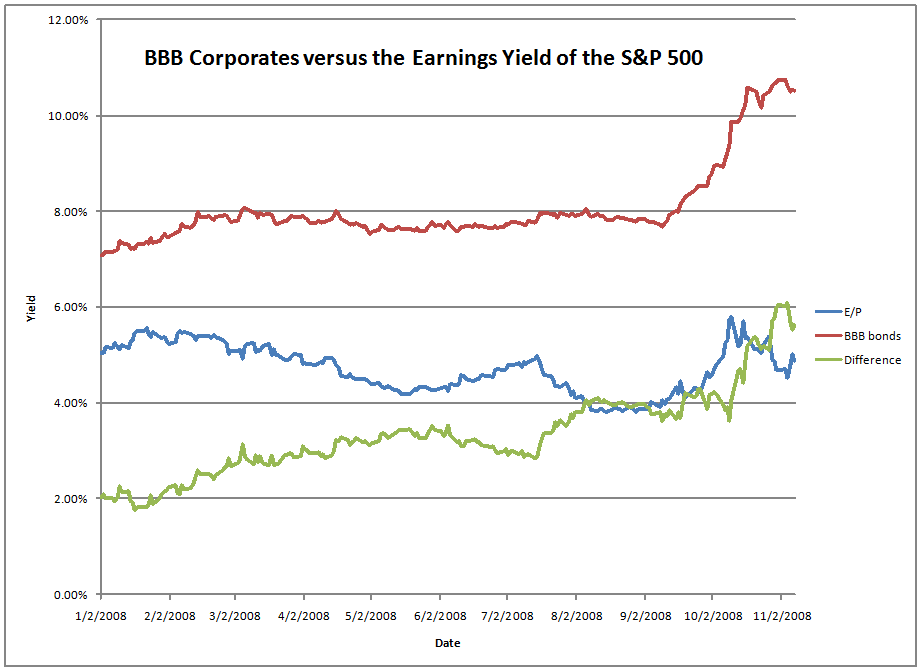
The key question is whether the yield on BBB corporates is more than 3.9% higher than the earnings yield on the S&P 500. The answer is yes, and that means we should sell stocks and buy corporate bonds. But, here is the embarrassing thing for me. The first recent signal to sell stocks and buy bonds came in mid-August, but since I didn’t track the model regularly, I missed that. Since the original model worked off monthly data, even selling in early September would have preserved a lot of value. It is not as if corporate bonds have done well since August, but they have done much better than the S&P 500.

Here’s a graph summarizing 2008 via my model:

When the green line goes over 3.9%, it is time to buy corporate bonds. That is not a frequent occurrence; this model gives of signals only a few times per decade. Check out my original piece for more details.

So, with that, I offer my conclusions:

  • It is still time to allocate money to corporate bonds versus equities. Where I have flexibility with my own money, I am allocating money away from Equity and to BBB investment grade and high yield corporates.
  • Though there are a lot of reasons to worry, corporate yield spreads discount a lot of trouble.
  • The model indicates a fair value of the S&P 500 at around 700. Uh, I’m not predicting that, but if we hang around at yield levels like this for long, yes, the equity market will adjust to the competition. More likely is the equity market treads water while corporates rally.
  • A caveat I toss out is that all areas of the credit markets where the government is not meddling are disproportionately hurt, because investors are fleeing toward guaranteed areas. Thus, corporates are hurting.
  • College endowments and other investors that hate to buy conventional assets should consider corporates now. It is my bet that a portfolio of low investment grade and junk grade corporates will outperform a 60/40 portfolio of Stocks and T-Notes.
  • If you have the freedom to sell protection on a broad basket of corporates, this might be a good time to do it, when everyone else is scared to death. Time to insure corporate credit, perhaps.
  • One more caveat before I am done. The rule has only been tested on data since 1953. It is not depression-proof. I hope to gather the data from that era and validate the formula, but that will be difficult.

So, be careful out there, and remember that corporate bonds typically do better than stocks in a prolonged bear market for credit. Yield levels like the present typically bode well for corporate bonds versus stocks.

Harvard, Yale, et al, Down 25%-30%?

|

harvard_u_shield.jpgSources in the VC industry are hearing that some VC firms and PE firms are beginning to see defaults or delays on capital commitments from Limited Partners (endowments, pension funds) who are strapped for cash. We have not yet confirmed any of this, but here are more details.

The potentially larger story behind these reports is that some of the largest endowments and pension funds may have suffered enormous losses in the past few months, at least on a mark-to-market basis. For example, one of our sources has heard that most major university endowments (Harvard, Yale, Princeton, etc.) are down 25%-30% on a mark-to-market basis. Harvard is also reportedly trying to dump 1/3 of its private equity holdings to raise cash, which would be a seriously distressed move. [See Private Equity Online report below]

Here are notes from two VC conversations. Again, no details confirmed:

The most agressive LPs have been hurt the most. For example, a rumor is circulating that Columbia's endowment fund is illiquid [can't raise the cash it needs to fund current commitments]. Harvard is trying to sell 1/3 of its private equity portfolio at a steep discount in a secondary offering. You would only do this today if you are really in deep doo doo.

The market price for LP positions in VC funds on average is 75 cents on the dollar. Limited partnership positions in PE funds are selling for 50-60 cents on the dollar. This suggests that $50-$100 billion in value has gone in the past few months from PE funds alone.

The major university endowments are reportedly down 25-30% on a mark-to-market basis [sounds extreme, but certainly possible]. Big universities are heavily in commodities, PE, VC hedge funds, and very little in bonds. They are getting killed across the board

Pension funds are a little bit less aggressive but they also may be more exposed soon.

This certainly makes sense. Many endowments have been following Yale's example in recent years and are heavy on private equity, real-estate, commodities, and hedge funds, and all of these asset classes have been killed.

UPDATE: The WSJ spoke with Todd Miller, who runs a firm specializing in secondary marketing of private-equity partnerships. Todd's comments certainly seem to confirm what we're hearing. Excerpts:

Private Equity Analyst: The press has reported that a number of investors, including Harvard Management Co., are dealing with cash-flow issues in their private-equity portfolios, thanks to their large, relatively illiquid alternative-asset portfolios and the prospect of no capital flowing back into them as deal-making remains difficult. What’s going on?

Todd Miller: I can’t tell you how widespread it is. You have LPs who are overcommitted, and these are the premiere investors in private equity out there. The people who’ve been around a long time are the ones who are getting squeezed the most. People had self-funding PE programs and when you map out no distributions for the next two years and project capital calls to occur, PE becomes a massive portion of an entire program. The next shoe to drop may be the pension funds. I think we’re in the early innings of this. This is not just a short-term problem.

PEA: What’s going on with pricing for secondary sales? Are any deals getting done?

Miller: Pricing for secondary interests has dramatically decreased. Pricing has gone from 85% of NAV in the first half of 2008 to around 50% to 60% of NAV based on June 30 financial statements recently. Deals are still getting done, but it’s a major challenge.

PEA: The secondary market is fairly small. Are there enough buyers for all the supply that’s going to hit?

Miller: There’s going to be a supply/demand imbalance because there’s not enough capital to absorb all the secondary deal flow that’s coming over the next 12 months. We could see a dozen deals north of $1 billion in the next 12 months. That’s the thing that I don’t think people are getting. People who think they can tap the secondary market may be in for surprise.

UPDATE 2: Private Equity Online reports the Harvard news:

Harvard Management Company is looking to unload roughly $1.5 billion in private equity stakes in the secondary market.

A secondary market source described the university endowment, which had $36.9 billion in assets as of 30 June, as a highly sophisticated limited partner making a proactive decision to seek liquidity and rebalance its portfolio based on cash flow models.

Although the volume of supply in the secondary market has risen of late, secondary investors expect it to surge further in the first half of 2009 as more LPs make a similar move to access needed liquidity...

Harvard’s secondary sale will drive down prices in the secondaries market because it will take $1.5 billion of demand out of the market at a time when supply is not rising, the investor added.

For the 2009 fiscal year, Harvard has a target private equity allocation of 13 percent up from 11 percent for the 2008 fiscal year. The endowment currently has roughly $4.5 billion in private equity commitments, according to sister data web site Private Equity Connect.

Bloomberg and Wall Street Journal reported other details:

The Wall Street Journal reported today that the Cambridge, Massachusetts, school is seeking to drop about $1.5 billion in partnerships managed by companies including Bain Capital LLC.

Endowments such as Harvard's, the world's largest university fund, and pension-plan managers pumped a record $1.01 billion into buyout firms in 2006 and 2007 as they chased returns that exceeded those available from public stocks and bonds. They are scaling back as the credit shortage makes it almost impossible for buyout firms to acquire and sell companies, crimping investment profits.

Commitments to private-equity pools fell to a three-and-a- half year low of $82.3 billion in the third quarter, according to researcher Private Equity Intelligence Ltd. in London.

The Cash Panic Sweeping The VC Industry

|

flee.jpgWhy have VC firms and PE firms clamped down on investments so fast? Why are they shouting from the rooftops that portfolio companies had better start cutting costs immediately?

Well, for one thing, because they're not boneheads. This economy has the potential to become the worst economy since the Great Depression (it isn't yet, thankfully). VCs see this and understand that:

  1. Profitable exits are going to be a lot rarer in the next couple of years, and
  2. Potential investments--including current portfolio companies--are going to get a lot cheaper in the next few years (and, therefore, returns on future investments are going to get a lot higher than today's) .

That logic alone explains why money has gotten so tight so fast. But VC sources say there's also another important dynamic going on: The folks who supply the money that VCs invest--Limited Partners such as pension funds and endowments--are now strapped for cash because the values of their own portfolios have plummeted (and so many of the investments are illiquid). Some are reportedly beginning to default on or defer commitments. In VC-land, in other words, as elsewhere, the oxygen is being sucked out of the room.

Here are some notes from SAI conversations with two VC sources this morning:

There are now unbelievable difficulties in the LP world. Many of the best names are having liquidity problems. They are having trouble meeting capital calls from Private Equity and VC firms and need to sell stocks to get cash. Much of their stock portfolios are tied up in hedge funds with lockups, however, so they can't liquidate those positions.

Some Limited Partners are starting to default on their commitments to VC firms [this is scuttlebutt, not firsthand knowledge; the sources' firms have not seen defaults]. In some cases this can mean they lose their investment to date, but since the LPs think the the VC funds are going to be losers anyway it does not matter. Some second-tier VC funds are reportedly looking at the fine print to see if they can sue the LPs who don't follow through on their commitments.

[In case you don't know how VC funding works: When a VC "raises" a $100 million fund, what the firm really has done is gotten commitments from LPs that they will deliver $100 million over the life of the fund. The firm then issues "capital calls" over the next few years and gradually draws the money down. It is these calls that some LPs are reportedly starting to default on.]

The most agressive LPs have been hurt the most. For example, a rumor is circulating that Columbia's endowment fund is illiquid [can't raise the cash it needs to fund current commitments]. Harvard is trying to sell 1/3 of its private equity portfolio at a steep discount in a secondary offering. You would only do this today if you are really in deep doo doo.* [Private Equity Online is reporting this--see below]

The market price for LP positions in VC funds on average is 75 cents on the dollar. Limited partnership positions in PE funds are selling for 50-60 cents on the dollar. This suggests that $50-$100 billion in value has gone in the past few months from PE funds alone.

The major university endowments are reportedly down 25-30% on a mark-to-market basis [sounds extreme, but certainly possible]. Big universities are heavily in commodities, PE, VC hedge funds, and very little in bonds. They are getting killed across the board

Pension funds are a little bit less aggressive but they also may be more exposed soon.

We have only spoken to a couple of VCs about this, and we assume many firms are not affected. We have heard the endowment scuttlebutt before, though (Princeton was a name that came up a few weeks ago), and it makes sense: University endowments need to fund massive cash spending every year, but they also don't like to compromise annual returns by keeping much of the portfolio in cash. So now that the value of ALL assets has plummeted and so many endowment investments are subject to lock-ups, it certainly sounds plausible that the funds are having trouble raising necessary cash.

Any VCs or LPs care to weigh in? We'd love to hear from you. All sources obviously kept confidential. hblodget@alleyinsider.com.

See Also: Harvard, Yale, et al, Down 25%-30%?


Private Equity Online is reporting the Harvard news: Harvard Management Company is looking to unload roughly $1.5 billion in private equity stakes in the secondary market.

A secondary market source described the university endowment, which had $36.9 billion in assets as of 30 June, as a highly sophisticated limited partner making a proactive decision to seek liquidity and rebalance its portfolio based on cash flow models.

Although the volume of supply in the secondary market has risen of late, secondary investors expect it to surge further in the first half of 2009 as more LPs make a similar move to access needed liquidity...

Harvard’s secondary sale will drive down prices in the secondaries market because it will take $1.5 billion of demand out of the market at a time when supply is not rising, the investor added.

For the 2009 fiscal year, Harvard has a target private equity allocation of 13 percent up from 11 percent for the 2008 fiscal year. The endowment currently has roughly $4.5 billion in private equity commitments, according to sister data web site Private Equity Connect.

Saturday, November 08, 2008

Sale of Mortgages, Structured Products Might Kick Off This Coming Week

Merrill Lynch is planning to sell roughly $4 billion of distressed debt securities, including mortgages and complex investments, in a bid to cut its exposure to risky assets.

The financial institution joins a growing list of banks, hedge funds and large investors seeking buyers for their hard-to-sell assets as the global economic downturn threatens to further erode the value of debt investments.

The need for investors to reduce the amount of borrowed money used to fund their holdings is behind the growing number of such distressed asset sales. In the past three weeks, the total amount of debt circulated for auction in Europe and the U.S. has surpassed $12 billion.

Merrill, which is being acquired by Bank of America, is looking to sell its distressed assets by year end, according to a person familiar with the matter. Potential interested parties have already received sale documents, suggesting that the bank might start selling some of the debt this coming week.

Merrill's plans, and the auctions of debt that proceeded it, come as the U.S. Treasury is setting up its plan to buy toxic assets from qualifying banks, and possibly other institutions, under its Troubled Asset Relief Program. No start date has been confirmed, but applications for assistance are due by midmonth.

In the open market, many of the debt holders circulating their assets for sale in so-called bid lists have found buyers for a third or less of the total offered.

Merrill Lynch is expected to include mortgages and structured products, such as collateralized debt obligations, in its asset sale, according to people familiar with the matter. This type of debt has become increasingly hard to value since the market dried up more than a year ago.

In July, many had thought Merrill had put the bulk of its toxic-asset problem behind it when the bank sold CDOs originally valued at $30.6 billion for just $6.7 billion to private-equity firm Lone Star.

Ranieri Becomes Victim of Crisis as Franklin Seized

Nov. 8 (Bloomberg) -- Lewis Ranieri, who helped create the mortgage-securities market in the 1980s while at Salomon Brothers Inc., became a victim of its collapse after his Houston-based bank was seized.

Franklin Bank Corp., formed by Ranieri in 2002, was taken over by the Federal Deposit Insurance Corp., and its deposits handed over to Prosperity Bank, the FDIC said in an e-mailed statement yesterday. The failed bank's 46 offices will open as branches of Prosperity, the FDIC said.

Ranieri, 61, a former Salomon Brothers vice chairman, formed Franklin in 2002 and over the next four years expanded the bank's lending operations. While Franklin avoided the subprime mortgage market, his firm was burned by loans to builders in California, Arizona, Florida and Michigan, where foreclosures are among the highest in the U.S. In November 2006 and again a year later, he predicted the market would get worse.

``The subprime crisis has spread to other sectors of the housing market,'' Ranieri said in a conference call a year ago. It's ``having a significant effect on housing and builders.''

Franklin and Security Pacific Bank of Los Angeles became the 18th and 19th U.S. banks seized this year amid the worst housing crisis since the Great Depression. Franklin's $3.7 billion in deposits were assumed by Prosperity, and Security Pacific's $450.1 million in deposits are now controlled by San Diego-based PacWest Bancorp. All deposits from both banks are still insured, the FDIC said.

Banks Closing

Regulators this year have closed the most banks since 1993, and the collapses of Washington Mutual Inc. and IndyMac Bancorp Inc. were among the biggest in history. The housing slump and tight credit led to a $700 billion bank-rescue plan, and the U.S. Treasury is using the fund to buy $250 billion in preferred shares in banks to boost capital.

In May, Ranieri replaced Anthony Nocella as chief executive officer after accounting errors related to real-estate loans. Alan Master was promoted to CEO in August, freeing Ranieri to try to raise money. That month, the company said it expected a $102.5 million second-quarter loss following $87 million in total losses the previous two periods.

In building Franklin, Ranieri enlisted Nocella among five former executives of Bank United Corp., later sold to WaMu, to run the bank. Ranieri took the bank public in 2003 at $14.50 a share, and the stock peaked at $21.88 in October 2006. Franklin shares tumbled 33 percent to 26 cents yesterday.

Franklin's Decline

Franklin lost more than three-fourths of its market value during 2007 as bad home and commercial loans doubled. Ranieri said in December 2006 at an industry conference that investors in mortgage-backed bonds had no idea of the risks they were taking. Worldwide credit losses and writedowns linked to the mortgage meltdown have swelled to $688 billion, according to data compiled by Bloomberg. Ranieri's assistant said he wasn't available for comment yesterday.

``The residential side was not their problem, it was clearly the commercial side,'' said David Lykken, co-founder of Mortgage Banking Solutions, an Austin, Texas-based consulting firm. ``The reason it took a little longer is because that trailed residential,'' he said yesterday in an interview.

Prosperity, of El Campo, Texas, will assume Franklin's deposits, including brokered deposits, at a 1.7 percent premium. Prosperity will purchase $850 million of assets and the FDIC will retain the rest for later disposition, according to the statement. The FDIC estimates the transaction's costs to its insurance fund will be $1.4 billion to $1.6 billion.

Pacific Western agreed to assume Security Pacific's deposits at a 2 percent premium and buy $51.8 million of assets, with the FDIC keeping the rest. Security Pacific is the third California bank to close this year, after IndyMac and First Heritage Bank.

Cost of Failures

The FDIC oversees 8,451 institutions with $13.3 trillion in assets, and insures deposits of up to $250,000 per depositor per bank and the same amount for some retirement accounts. The agency has proposed doubling premiums charged to banks for coverage, to replenish its reserves amid agency forecasts that bank failures through 2013 will cost almost $40 billion.

The FDIC in August said 117 banks were classified as ``problem'' in the second quarter, a 30 percent jump from the first quarter. The agency, which doesn't name ``problem'' lenders, will update its assessment this month.

``Banks overall are very well capitalized,'' FDIC Chairman Sheila Bair told the Senate Banking Committee on Oct. 23. ``We have some banks with some challenges, but the vast majority are well capitalized.''

The U.S. closed 27 banks from October 2000 through the end of last year, according to a list at fdic.gov.

Feed the World -- and Boost Returns

INTERVIEW
Donald Coxe, Global Portfolio Strategist, BMO Financial Group

AN INTERVIEW WITH DONALD COXE: He's convinced that we are in the midst of the greatest commodities bull market of all time. His hunger: food.

ONCE A WEEK, LOADS OF INSTITUTIONAL INVESTORS DROP whatever they're doing to tune in to Donald Coxe's strategy conference calls. Small wonder. With a keen sense of history and wry sense of humor, Coxe has helped his followers anticipate some of the biggest shifts in markets, be they in stocks or commodities. As global portfolio strategist for BMO Financial Group, a Toronto-based bank that is among Canada's largest, he now sees real hope for two sectors that have been taking poundings: banks and commodities. Though he launched the Coxe Commodity Strategy Fund this past summer, right before commodities took a nose dive, Coxe remains convinced that we are in the midst of the greatest commodities bull market of all time. For his reasons, please read on.

[interview]
Matthew Furman for Barron's
"The gigantic investment returns are all going to be tied to companies that meet real human needs and do it better than other companies. What a great time to be an investor."--Donald Coxe

Barron's: What's your take on the monetary scene?

Coxe: The Fed has doubled the debt on its balance sheet in five weeks. We don't know how long they are going to be carrying out these policies, which would send Milton Friedman spinning in his tomb. On the other hand, they had to do it. I challenged groups this week, saying, if I had said to you a year ago things will be so bad that the Fed will double its balance sheet in five weeks, would any of you have ever invited me back to speak to you? And, of course, the reaction was the same: Clearly you are stark raving mad.

Are the economic prospects any better in Europe?

The Europeans had thought it was an American problem, but European banks have lent a vast percentage of their capital to these Slavic countries, with even worse demography than Europe. Emerging markets are such a powerful asset class because each generation is bigger than the next, and there is an increasing middle class and a high savings rate. That's the stuff of real economic power, and a terrific investment concept. By contrast, in the OECD countries, each generation is just 60% of the predecessor generation, there's no growing middle class and there's a zero savings rate. The formula across the OECD is for sluggish growth at best.

How should investors approach today's stock market?


DOW JONES REPRINTS
This copy is for your personal, non-commercial use only. To order presentation-ready copies for distribution to your colleagues, clients or customers, use the Order Reprints tool at the bottom of any article or visit: www.djreprints.com. • See a sample reprint in PDF format • Order a reprint of this article now.

If you aren't deeply in the equity market, this is not a time to be committing large amounts of money. Stocks are cheap but they can get cheaper; we know that. We got back to the Dow having a multiple of 5.9 in December of '74, which was the foundation of Warren Buffett's wealth because he started buying at that level. The Dow isn't anywhere near 5.9 [its multiple last week was 11], but some of my favorite stocks are trading at lower P/Es than that. I can tell you they are the fertilizer, oil and agricultural companies.

Tell us some more about those industries.

The core investment concept of our time is that we are living through the greatest simultaneous effervescence of personal economic liberty in history. When people go from abject poverty to dwellings with indoor plumbing, electricity, basic appliances and access to motorized transportation, they have more economic liberty than 99% of humanity enjoys and we are adding 50 to 150 million people a year to that list. The gigantic investment returns are all going to be tied to companies that meet real human needs and do it better than other companies. What a great time to be an investor, because it is not just about the dwellings and the transportation, it is about the high-protein diet. When I came back from a trip two years ago, I said the biggest commodity story is going to be food, bigger than the other ones. It is high-protein food. The way to play that is through the fertilizer stocks, the genetically modified seed stocks and the farm-equipment stocks. [Coxe would not recommend specific companies, citing his firm's compliance restrictions.]

What are the big trends in food consumption?

If you look at areas under cultivation, wheat has only gone up in hectares a little bit in a decade. Rice is flat in a decade. Meanwhile, our need for protein has gone up dramatically because people are consuming more beef and pork. But more important than oil in this decade is milk. In rural India, the kids are getting animal protein and they are going to be physically stronger than their parents. Their brains are going to be better.

But there's still a serious global food shortage.

Until four months ago, when you Googled "global 'blank' crisis" it was the global food crisis. The global food crisis was our big theme. The global financial crisis has pushed the food crisis off the front page at a time when people are actually getting together to say, "How do we deal with this problem?" We have an enormous challenge, but we also have the technology to increase farm productivity. Investors who invest in this are going to make a lot of money, and they don't have to apologize to anybody for doing it. If it hadn't been for [the development of genetically modified crops], corn would have gone to $10 a bushel [instead of a recent high of $7.50] and we would have had another 100 million people starving. This is a great investment theme.

Which commodity groups do you like best?

Agriculture is first. We will need more fertilizer. There are only three farm-equipment companies of any size in the world. Terms of entry are difficult. You have to have dealerships. CNH Global [ticker: CNH] is one of the top three companies in the world in the field. It's a subsidiary of Fiat and its stock has collapsed, but earnings haven't collapsed. In May it sold for $45 a share. It's $17 now. The next group has to be gold stocks. A period of massive reflation always leads to a good move in gold.

Next?

The third group is energy. Despite Obama's plan to spend $150 billion on alternative energy, each year we still lose 4.5 million barrels of oil a day that we have to replace. Oil is trading now at $61 a barrel, but oil for delivery in 2015 is trading at over $90 a barrel. Those with reserves in politically secure areas of the world will do well. Venezuela could solve a large part of the world's energy needs, but not under the current management.

How about base metals?

Those stocks are selling for pennies on the dollar. Take BHP Billiton [BHP]. It was $95 in May, it recently fell to $30, but it's back up to nearly $40. This is an unrivaled set of assets, a great balance sheet, top-notch management and no scandals.

Is copper worth a look?

Copper is now at $1.80 per pound, where it was in '05. But as soon as the economy recovers, copper always doubles in price. It's levered to growth in China and India. They have an increasing percentage of well-off people who use energy and metals, and each generation is bigger than the last. Since 1995, China has had a plan to create 200 cities of more than one million people. The investment strategy should be tied to areas of the world that are growing the fastest in the next five years.

As for stocks in general, when will we know that they're ready to rebound?

In every bear market since 1972, when the banks went through a period of at least six weeks where they outperformed the S&P, it was over. But we can't use the rule this time because of the TED spread, which has a 100% forecasting record in all bear markets.

[chart]

You have our attention.

The TED spread is the spread between the front-month T-bill contract and the front-month Eurodollar contract, because the Eurodollar contract is uninsured deposits in banks around the world in dollars. Therefore it is the measure of risk in the system. It reached a high of 500 after Lehman Brothers collapsed. The highest reading we have ever had up till then was 415 when Continental Illinois bank went bust in 1984 and got saved in order to save the system. The only reason they knew they had to save it was because of the spike in the TED spread. I know that from having interviewed the people involved. I used it to predict the crash in 1987. Then there was a long period where my knowledge of the TED spread was useless.

What does TED tell us now?

The spread has fallen to a little under 200 because of the various bank-rescue programs, and it could easily get to 140-145, which signal that banks are in a position to start lending again.

Does that favor any particular sector?

As they put this money into the banking system, then the oddity is that when the bear market ends, the bank stocks will be among the leaders in the rally that will come. This is based also on the principle of redemption and religion, which holds that when you have redeemed your sin you can come into heaven. When the bankers have stopped sinning and have gone through enough penance, then...

How do we know this will happen?

The TED spread certifies for bankers collectively they are entitled to go to heaven because it indicates they have gotten their balance sheets in order and the system is working again and money is flowing more freely.

Which banks are you buying?

We like those that show that they actually had a pretty good risk culture beforehand, but a couple of mistakes were made. The system is shot through with corrupt practices.

Thank you, Don.

Crash Course

BARRON'S COVER
By ANDREW BARY

Many college endowments are learning that they can't make the grade by simply copying the work of star investors. Rethinking alternative assets.

THE GLOBAL BEAR MARKET HAS DEALT ONE OF THE BIGGEST BLOWS in decades to college and university endowments, prompting administrators across the country to cut budgets, freeze hiring and scale back ambitious building projects.

It's tough to gauge precisely the extent of the woes because most big universities haven't released information on their endowment returns since June 30, the traditional end of the academic fiscal year. Based on anecdotal evidence, however, and the turmoil in financial markets, the numbers aren't pretty.

[pic]
Darren McCollester/Newsmakers; Vincent DeWitt/Sipa Press; Newscom
Endowment dollars have helped build impressive campuses at Harvard, top and right, and Princeton.

The president of Amherst, a Massachusetts liberal-arts college, recently said its endowment is off about 25% since June 30, when it totaled $1.7 billion. Maine's Colby College said its endowment has fallen by a similar amount since its peak a year ago. Wesleyan, in Middletown, Conn., is delaying the construction of a major science building and filling vacant positions only when necessary, to help cut $10 million to $15 million in expenses in the next few years. Cornell is freezing most hiring and delaying new projects.

The three super-rich Ivies -- Harvard, Yale and Princeton -- also are getting pinched, although few will cry for them. They've been trend-setters over the past decade, generating superlative returns from an asset-allocation mix that looks nothing like what individuals typically maintain. These schools are light on U.S. stocks and bonds, and heavy on illiquid assets, such as private-equity, real-estate and commodity holdings, and hedge funds.

Now these schools' endowment managers ought to be considering more investments in stocks and bonds, as alternative assets have offered too little diversification and liquidity while generating returns that indeed are correlated with the miserable ones now being turned in by the stock market.

With major U.S. stock indexes trading below their levels of a decade ago, and yields on corporate bonds at juicy levels, it could be time to switch back to conventional assets, which look inexpensive and cost less to buy.


DOW JONES REPRINTS
This copy is for your personal, non-commercial use only. To order presentation-ready copies for distribution to your colleagues, clients or customers, use the Order Reprints tool at the bottom of any article or visit: www.djreprints.com. • See a sample reprint in PDF format • Order a reprint of this article now.

Reflecting the philosophy of David Swensen, its influential endowment director of the past 23 years, Yale has 70% of its endowment invested in three categories: hedge funds, private equity and "real" assets, including timber, real estate and oil- and-gas properties -- one of the most aggressive allocations among major endowments. Princeton similarly has 70% in hedge funds, private equity and real assets, while Harvard has 57% in those groups.

THE IVIES' RESULTS IN the past 10 years have been very impressive. Harvard's endowment was up an average of 13.8% annually, bringing it to $36.9 billion as of June 30, tops in the academic world. Yale's endowment grew at an average annual pace of 16.3% in the same span, to $22.9 billion, making it second to Harvard in size. Princeton's endowment rose at a 14.9% annual clip, to $16.4 billion. Stanford, in Palo Alto, Calif., also has shined; its endowment rose by 14.2% a year, to $20.4 billion.

These returns compare with the 6% yearly advance for the average institutional portfolio, and 3% for the S&P 500 over the same decade. Yale calculates it has added an extra $13 billion to its endowment, compared with how it would have done with the performance of the typical college endowment.

The growing endowment wealth has enabled the schools to upgrade their facilities, expand enrollment and boost financial aid for students. And a lot of less well-endowed schools have used the same investment strategies in an effort to catch up.

But times -- and markets -- change. Even if the markets resume rallying, the endowments of the Big Three Ivies could trail more conservative peers in the current fiscal year. Harvard, Yale and Princeton aren't saying anything specific about their returns. But on the basis of their reported asset allocations, we estimate each could be down 25% or more since June 30 if they were to assign realistic values to their illiquid investments.

Private equity, for instance, is a disaster, despite what optimists like Steve Schwarzman, the CEO of Blackstone Group (ticker: BX), assert. (See here.) There probably isn't much equity value in most of the leveraged buyouts completed during the bubble years of 2006 and 2007, owing to the weak economy, overleveraged balance sheets and declining values of comparable public companies.

[table]

If this argument seems extreme, consider AP Alternative Assets and KKR Private Equity Investors, formed to invest in deals engineered by their sponsors, buyout specialists Apollo Management and Kohlberg, Kravis Roberts. The KKR vehicle wrote down the value of its assets by 15% in the third quarter. More important, shares of these companies, traded in Europe, fetch about 25% of the asset values assigned by their managers, indicating that investors don't believe the valuations provided by Apollo and KKR.

With cash-strapped endowments and other institutional investors looking to sell some of their private-equity funds, an informal secondary market is developing. The going rate is said to be about 50% of stated investment values.

Commodities -- another favored asset class -- have plummeted more than 40% since June 30, with publicly traded oil-and-gas stocks off 50%. Real-estate investment trusts are down 35%. (The S&P 500 is off 28% in that span.)

Timberland prices rose to ridiculous levels this year despite weak markets for wood. The catalyst: what one Wall Street analyst called a "frenzy" of buying by endowments seeking to emulate Harvard, a longtime holder with a 9% allocation -- nearly as much as its 11% holding in U.S. stocks. In May, Chip Dillon, a former Citigroup forest-products analyst, wrote that timberland was selling at 20 to 30 times annual pretax cash flow. If the Ivies are carrying their timber at those levels, they'll have to make major downward adjustments. Emerging-market stocks, another Ivy favorite, also have been crushed, falling by 45% since June.

A key question all endowment chiefs should ask is: "How does the valuation of our illiquid investments compare with those of comparable public companies?"

Another question: "If private-equity funds are being sold at half of net asset value, should we keep ours at 100%?"

Swensen, the most influential investor in the nonprofit world, has argued that endowments, with a long time horizon, are ideally suited to buy illiquid investments where market inefficiencies can be best exploited. Low-return bonds should be kept to a minimum, in his view.

"The heavy allocation to nontraditional asset classes stems from their return potential and diversifying power," Yale wrote in its endowment report last year. "Yale is not particularly attracted to fixed-income assets, as they have the lowest historical and expected returns of the six asset classes that make up the endowment."

YALE WAS BULLISH ON private equity as recently as the summer of 2007, just before the bottom fell out of that market. The endowment then raised its targeted private-equity allocation to 19% from 17%, citing "bottom-up opportunities, even in this heated market." Princeton has about a quarter of its endowment in private equity.

The Swensen approach may be too aggressive, particularly for endowments that need access to their money and have less skilled managers than Yale's. Endowments typically must disburse 5% of their value every year to support university operations.

One unpleasant twist: Private-equity firms are asking endowments and public pension funds to fork over cash committed, but not invested, when the markets were much stronger. The private-equity outfits are eager to recoup losses on bad leveraged buyouts by making new investments.

In a typical private-equity arrangement, a college would agree to invest a certain sum, say $10 million, with a firm like Blackstone or KKR, which would request the money only when suitable opportunities arose. Unfortunately, in a bad market like today's, distributions from already-made private-equity investments could dry up at the very time the private-equity firm is asking the college for some or all of the money it had pledged to make available for new private-equity investments. This mismatch can force the college to put, say, 18% of its endowment in private-equity holdings, even though it might have planned to invest no more than 10% at anytime.

The capital calls from private-equity firms are squeezing endowments and pension funds, including the giant California Public Employees Retirement System. Between spending needs and such capital calls, some endowments may have to liquidate 10% of their assets in the current fiscal year, one investor tells Barron's. No wonder endowments have been selling stocks, among their most liquid assets.

[table]

Even Harvard appears to be facing this problem. The Wall Street Journal reported last week that the university was marketing about $1.5 billion in private-equity funds. That's stunning, considering it is an awful time to be selling such holdings. It's unknown whether Harvard found a buyer.

JEREMY GRANTHAM, THE HEAD of GMO, a large Boston investment firm, worries less about Yale than about the hundreds of Yale wannabes. "It's obvious to me that few of those emulating Yale have the resources of Yale and the talent of Yale to pick the right managers," he says. Yale, like most endowments, farms out the bulk of its assets to outside money managers.

The pressure to follow Yale was intense at other colleges, foundations and charities. "The charities have all these consultants, and they've been herding the buffalo in one direction, toward alternatives," says Thomas Kahn, president of Kahn Brothers, a New York investment firm. "The consultants say: 'Yale has alternatives. Harvard does. Look how well they've done. You've got to have 20% in hedge funds.' "

The hedge-fund talent pool isn't deep, and the Ivies have locked up some of the top managers. The blow-ups in the hedge-fund industry may cause a reassessment of this trend. Grantham believes that, given their high fees, hedge funds over all create little value for investors.

Endowment declines of 25% would hardly be disastrous for Harvard, Yale and Princeton, but such losses would matter mightily at smaller institutions.

That's why it may be time for most colleges and nonprofits, which can't afford to hire the very best talent, to move away from the pack and to rethink any heavy exposure to illiquid investments, especially when so many opportunities seem to beckon in global stock and bond markets.

As master investor Warren Buffett has noted, there's an inevitable trend in many pursuits, including money management: First come the innovators, then the imitators and, finally, the idiots. Or as Charles Darwin might put it: Those who don't evolve pay the price.

Tuesday, November 04, 2008

"Full House" Buy Signal For European Equities

European equities got a boost this morning following bullish comments made by Morgan Stanley's European strategist Teun Draaisma. Draaisma commented that European stocks are now flashing a "full house" buy signal after these markets have priced in an earnings recession, and retail investors, purchasing managers, and sell-side analysts have all capitulated.

While we don't normally highlight specific calls by strategists, we think Draaisma's prior calls are worth pointing out. Judging by the buy and sell signals that we were able to document since 1996, his calls have been pretty timely.

DJ Euro Stoxx Index

Time to Ditch the Style Box

If you were trying to create a system for controlling investment risk in equity investing, how would you do it? What I would do is look at the factors that are the least positively correlated in terms of return generation, and focus on them.

But what do investment managements consultants do? They divide the world up into managers that look at two factors: large/mid/small capitalization, and value/core/growth. This has been popularized by the Morningstar “Style Box.”

Looking over the last 15 years, the style box is very correlated with itself. The lowest correlation is 75%, between largecap value and smallcap growth. That is not a reason to categorize managers; the difference between the average largecap value and growth manger is teensy. It is even true between largecap value and smallcap growth. And in more recent years, the correlations have been tightening to nearly 90% at worst.

So, consider country allocations. Over the last 15 years, the correlations in developed markets have been 45% at worst, with the average being near 70%. Looking at the last few years, both figures are higher. My opinion: the advent of naive quantitative investing has pushed all correlations higher.

But now consider correlations across economic sectors. Over the past 14 years, the correlations have been 32% at worst. Across industries, which are more diverse than sectors, some of the correlations are negative, perhaps affording true diversification.

My point here is that those that look at capitalization size and value/growth are missing the boat. If you classify managers based on that, you are focusing on minor concerns that do not aid much in diversification. Better to focus on the industries that a manager invests in, and/or the countries that those companies are located in — there is a real oportunity to limit risks through either of those two methods.

Now, as for me, when I pick stocks, I start with the industry. I ignore the factors in the style box. I look for industries that are near the bottom of their pricing cycle, and buy the highest quality companies there. For industries that are doing well, but are undervalued, I buy companies with undervalued growth prospects, with good quality balance sheets.

I strongly believe that the investment consultant community has shortchanged its clients by focusing on the “style box.” Very little of the risks of the market result from factors in the style box, while much resluts from industry selection, which is a richer model.

So, as for me, if I have to be squeezed into the style box, call me midcap value with some style drift, buying companies larger and smaller, and outside the US, as conditions dictate. I’m looking for the best value over the next three years, and I don’t like non-economic factors distracting me. Why should that be such a crime, that the ignorant gatekeepers screen me out?

The risk model for the investment consultants is broken. Let them find one that better reflects the way that the market works.

Why Draaisma is saying Buy, Buy, Buy, Buy

Apparently we’ve got the strongest signal to buy equities in six years, according to Morgan Stanley’s super-bear bull Teun Draaisma - a “full house” of indicators that together have a “near-perfect” track record. But what are those indicators?

First there is composite valuation:

2715.jpg

This is a traditional tool comparing equity valuations with inflation and official interest rates, the strategist says. Morgan Stanley uses a variety of weighted indices on real and nominal bond yields, dividend yields, short rates, and some equity valuation factors like price earnings multiples and price-to-book valuations to construct its so-called CVI index. If equities are fairly valued at zero, the buy and sell levels are -1 and +1, respectively.

Next up, the fundamentals indicator…

2717.jpg

Risk…

2719.jpg
And finally “capitulation.”

2721.jpg
Draaisma says simply that the calculations for these indicators are broadly similar to the composite value measure, but include factors like business surveys, ROE, bond yields, credit spreads, fund flows, money supply, and momentum.

Not convinced yet? Here’s 28 years of history:

2723.jpg

Sunday, November 02, 2008

October Stock Performance

On October 10th, we noted that Black October was in the works, and even though we had a big rally last week, the average stock in the S&P 500 was down 20.88% for the month. In fact, just 28 stocks in the index were up on the month. Below we highlight the 25 best and worst performing stocks in the S&P 500 in October. As shown, Wachovia (WB) was up the most at 83.14%. Unfortunately, it is still down 83.15% on the year! WB was followed by National City, First Horizon, Huntington Bancshares, and Apollo Group. Stocks that were up during the month that are also up for the year include SWN, FDO, GAS, AZO, HCBK, UST, CELG and AMGN.

On the downside, Hartford Financial Services (HIG) was the biggest loser, declining 74.82% in October. Not far behind were General Growth Properties (GGP) at -72.58% and Prologis (PLD) at -66%. Other notables on the list of big losers for the month include CVH, F, X, AA, S, and WFMI.

Fortunately, October is now over and November is a new month. To receive in-depth analysis on how to play the market for the rest of the year, subscribe to Bespoke Premium today.

Bestoctober

Worstoctober

Lunch is for wimps

Lunch is for wimps
It's not a question of enough, pal. It's a zero sum game, somebody wins, somebody loses. Money itself isn't lost or made, it's simply transferred from one perception to another.